Showing posts with label pbl. Show all posts

Saturday, March 14, 2015

Educational Intoxication

This week, a team of six teachers from our school and I were fortunate enough to attend High Tech High in San Diego.  Several years ago I had heard Larry Rosenstock, the founder of High Tech High, speak at a conference that I attended.  I was captivated by his ideas around the equity in education, and the importance for schools to engage the heads, hearts and hands of children and teachers through project-based learning.  In order for our school to begin the process of articulating a guiding vision, I brought HTH teachers Chris Wakefield and Anthony Conwright to Sa-Hali last May to introduce the concepts of PBL to our school, and to open up a dialogue about the possibilities that a PBL approach could have for our students and staff.  And this February, after our Instructional Rounds observation team helped us discover that we need to develop tasks that enable our students to demonstrate our attributes of creativity, collaboration, and resilience, I knew it was high time for us to get to High Tech High. And as I sit here on the plane ride home looking back on the last three days, I realize that I will fail miserably at doing justice to describing the feelings I had during the experience, however, in the innovative spirit of “don’t worry, be crappy” from Guy Kawasaki--here goes my set of random thoughts. (I will blog more about more 'structural' things and 'what nexts', but this one will be more about the ‘feel’ of the place).


The moment that our stepped on to the campus (or campuses, as there are five schools on the property), we immediately felt welcome.  That might sound a tad cliche, so let me qualify ‘welcome’:  people were not just happy to see us, they were eager to see us.  High Tech High gets hundreds of visitors each year, yet students, staff, directors, support staff and, well, pretty much anyone around the campus wanted to talk to us.   And then, like a wave, this palpable and tangible culture washed over us.


Some random thoughts and memories...


  • Students sitting in classes would invite us (and even pull us!) into their classrooms and immediately start talking about what they were doing and why they were doing it.  They would grab a couple of friends or classmates and say things like “look at Alicia’s comic strip, it’s REALLY cool”, and then Alicia would tell you about the why they were doing the project and about feedback and iterations she went through to make her project better.  There were dozens and dozens of kids in hallways and open spaces that would say hello and would take the time to answer questions, or give directions, or ask about you and where you were from. Classrooms were open to anyone.  
  • Teachers I met (and I met dozens) in a hallway or meeting would say things like “Don’t forget, my name is Rob, and I teach in the end classroom of the far hallway.  Make sure you see what we’re doing today.”.  Or they would ask you what you were interested in, and then say “You know who you need to talk to?  Tom.  He is doing something that’s right up your alley with his kids today.  He’d really want you to see it.”.  And when you went to see Tom, he would say to you “Cool, I saw Jeff at lunch today and he said you would be stopping in, come sit with a couple of students!”
  • If you made a request, maybe something something like “Would it be possible to chat with a Director (we call them Principals) for a few minutes?”, our host Angela would set up meeting with two Directors from different schools so that you could get a few different perspectives.  Everyone made time for you, and no one was flustered or exasperated to do so.  Quite the opposite in fact, they wanted to share!  When I asked a senior Humanities teacher about this, he said “I do a lot of work to prepare my day so that I can spend time talking to people like you so I can learn more.  The kids are working and learning, and I am working and learning.  It just seems to make sense.”  
  • When teachers were chatting with you, the students were WORKING--peer critiquing, walking into another classroom to get something, sprawling across desks, and helping eachother.  But they were also RELAXING.  In fact, one of the Grade 6 teachers said that he didn’t want his students to “go too easy or too hard”.  When I asked him why, he said because learning is supposed to be enjoyable, NOT work.”
  • If you had an idea for a project, the school get a chunk of time to do a tuning protocol seemingly out of thin air.  Suddenly, there would be a group of HTH teachers who were on lunch break or prep gathered around you in a room, and the protocol would begin, and 20 minutes later, ideas were amplified, modified, critiqued, and made better.  Much better.
  • If you had a question, staff members would ask more questions of you, give you ideas, give you a book reference or an online resource, and then physically take you immediately to someone else who might be able to help.
  • All Meetings were wide open to visitors.  I went to a planning meeting, and even a faculty meeting.  At the faculty meeting, every single person made me feel welcome there, asked me questions about our school, and wanted me to participate in the activities.  “Why wouldn’t you?  We always need more good ideas!” people would say.  The tone was relaxed, fun, friendly, and the work got done.  One of the staff members led a fun primer activity about Pi Day to get people talking to others that they hadn’t seen all week.  Then, in the carousel activity we did, the leader didn’t assign people to groups or tell them to start in different spots, but instead said “I know you all of you will want to make sure you visit each of the stations to see if  the ideas people are sharing spark new ones for you”.  And who’d believe it, people moved about the room to the different stations, dialoguing with whomever was there, bouncing ideas off each other, and jotting thoughts down.  At one point, one teacher commented on the attendance to the student sign-up X block that HTH has in their timetable.  Another said, “I guess we should be doing something worth doing then!”, and the other person agreed, and they moved along.


I could honestly go on.  And on.  And on.  And in future posts I will. But in our closing meeting with our host Angela, she asked for each of our ‘takeaways’ for the week.  And as we were sitting there, a thought hit me.


Many people may think of High Tech High as a sort of unattainable educational utopia.  They erroneously may feel that it is some sort of elite, private, wealthy school with limitless resources and ‘gifted’ students (whatever that means…). They might be blinded by pictures of projects and palm trees, robots and resources, and some bit of technology in every child’s hands.  And because of this, educators in other, more ‘traditional’ schools might easily become discouraged with what ‘they don’t have’ compared to the perception of the resources they see at High Tech High.  


But High Tech High is not private, it is publicly funded according to daily student attendance. Their students come from every zip code in the San Diego area, regardless of socioeconomic status. The school has funding constraints just like my school does.  They do not have endless piles of money or resources--they have to make cuts and tough choices just like the rest of us. Their students are just kids like any other kids; they talk, text, laugh, get bored, and have attention spans identical in length to every student that I have met.


But there IS one thing that would make me think of High Tech High as ‘elite’.  There IS something that our group wholeheartedly agreed that was truly limitless in supply, and that has changed my thinking as an educator and as a person.


High Tech High is elite in its limitless commitment to the idea of service to others.  From students and teachers alike, we felt this culture in each of the schools from the moment we got there.  People were helping people. They were celebrating risk-taking and amplifying ideas for the greater good. And for a brief couple of days, we seven were invited to be a part of it. It was educationally intoxicating, and to a person in our group, this culture of service was why none of us really wanted to leave.

I look forward to the conversations and questions that will arise from our visit to High Tech High going forward at Sa-Hali. To try to replicate what High Tech High does would be impossible, and not something I would wish to do. Before I came to HTH, I had my own driving question that I was hoping to have our school community take on as a project, which was "How can we enable our people to do their best work?". However, HTH has inspired me to change my driving question to "How can we enable our people to do their best work in service to others?" and co-create our own feeling of 'educational intoxication' for our students, staff and community.

I want to thank our team that attended HTH - Jordan Backman, Susanne Blohm, Tanya Cail, Jen Cacaci, Cecile McVittie, and Kirk Smith.  The professionalism that you showed, the questions you asked, and your willingness to learn would make any Sa-Hali student, staff member or parent proud.

I also want to thank Chris Wakefield for inviting us HTH, Angela Guerrero for her passion in being the most accommodating host, and the entire HTH community for opening your doors and your arms to us!

Friday, January 30, 2015

Authentic Accountability

New Year's Resolutions are always interesting to me. Typically, I would make a whole host of lofty proclamations on December 31st to a few vaguely interested peers who themselves would be unlikely to repeat a single one my goals more than three minutes later.  For a few days or perhaps even weeks after I might pull the kids' snowsuits off of the treadmill, eat quinoa every meal, and drink sixteen cups of water a day in an attempt to squeeze into clothes that I purchased at a time when I believed the scale in the bathroom was much more accurate than at present. However, after a few weeks, much like the resolutions that I had made to a couple of buddies, my efforts would fade, and I would be right back where I was prior to the start of the year.  Pass the cured meats, please.

Just prior to the Christmas Break, our school made a type of 'resolution'.  After months of our faculty working hard to co-develop our "Attributes of a Graduate" , we developed our driving question to help us move our attributes of collaboration, creativity, and resilience (CCR) at our school from theory to reality.  Our question was "How do we get these attributes into the heads, hearts, and hands of our students?".

After our staff did a ton of initial planning at the December ProD, we also had to confront a couple of realities for anyone in education:  firstly, anyone over the age of 30 is considered to be "old" to our students, and secondly, "old people" like us are basically incapable of understanding what kids would actually find to be "cool" in terms of a presentation such as this.  (That I have even used the term "cool" as opposed to "sick" or some similar term demonstrates my own nerdiness).  So, we created our own "Sa-Hali Project Tuning Protocol" modified from the High Tech High Tuning Protocol, and assembled six of our students to work with our presentation project lead team.  We wanted to go "soft on the people, hard on the content" to determine whether our presentation would in fact get in to the heads, hearts and hands of our students.

I cannot underscore this point more:  the power of project tuning with students is something that truly has to be experienced to be understood.  The comments and suggestions from students were thoughtful and honest, and at the end of the process, each of the students said they were glad to be a part of co-creating something for the rest of the student body.  The people in the room developed a bond that day and without question, the presentation was immediately better than it would have been. It was better not just because the participants had a student's perspective, but because they were people that had really good ideas and cared deeply about their school.  Awesome.

So, back to my bit about resolutions.  Once we began the project tune, we had crossed a threshold--suddenly, our staff had "outed" itself.  Figuratively, it was December 31st, and we were telling these six students that we were going to do something different.  And to put even more pressure on ourselves, we were getting them to help us find a way to make the other 775 students and all of their parents remember the fact that we were going to be doing something different.  That creativity, collaboration, and resilience were going to be our focus from this point going forward.  Uh oh.  Not so fast on the cured meats.

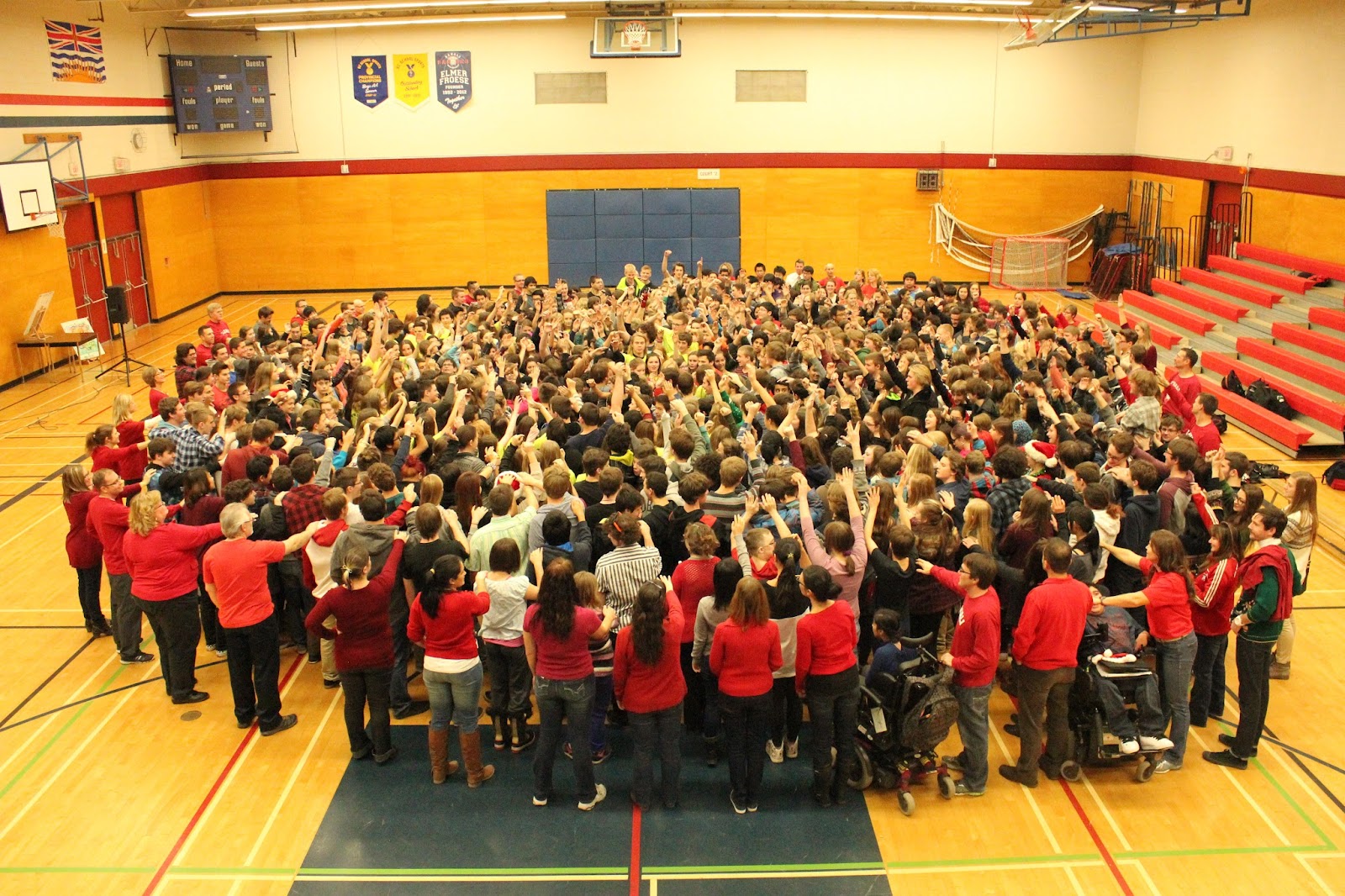
The hard work of our staff and students culminated in our first ever "CCR Attributes Assembly".  I won't lie, I was tremendously nervous.  Usually, assemblies were something to do with spirit, pep rallies, holiday celebrations, or messages from the community.  But this assembly concept was totally different, unique, and untested.  As well, while I was doing the introductory segment of the assembly, the rest of the staff had self-organized into three attribute groups that all had equal (and equally as vital) pieces in the show.  While I had helped with providing a framework for the other parts and our kids had 'tuned' them,  I had not actually seen what the groups were going to do.  Not to mention, each of them had a physical task for kids and staff to do that would reinforce the importance of our attributes. Inasmuch as I had referenced innovator Guy Kawasaki and his "don't worry, be crappy" mantra, and had told our staff we needed to get on with it, this was getting a bit crazy.  It was all on the line in front of 775 kids!  We couldn't walk away from this New Year's resolution--aka. #thisishappening

Together - Attributes.jpg
Our culminating symbol for resilience--WE will do this TOGETHER.
...and it all came together.  The whole school came together because we all did it together, for each other and in front of each other.  And it was awesome.

This process has made me question what authentic accountability really means.  As a staff, a lead team, and a project-tuning team, we were accountable to each other.  We were accountable to a highly visible product and a large and interested group.  But there were no grades.  No percentages.  No rubric.  There was no one giving us a thumbs up or a thumbs down.  There was just our own sense of pride in doing our best work for each other and for an audience because they were there, and they would be watching us.

We will continue to make ourselves accountable to each other, to our students and to our parents.  As much as we co-created this assembly to promote our attributes, to get feedback about these attributes, and to find out where our students and staff wanted to get started with these attributes, we also are creating our plan to develop these attributes that we will project tune with another group of students and parents so we can make our vision of a graduate become a reality for every one of our students.  And by creating our own authentic accountability checkpoints to eachother and to our community, we can avoid CCR becoming little more than a New Year's Resolution and keep ourselves on track to achieve our goal of producing graduates that are creative, collaborative, and resilient.

Friday, December 5, 2014

"Don't Worry, Be Crappy"

I have never blogged 'real-time', in the 'between slots' while facilitating a professional development session - a new challenge, so here goes!

Toady, we had our December Professional Development Day.  The day was co-created and tuned by our PD committee, and was a continuation of our thread of Attributes of a Sa-Hali Graduate.  Now that we have landed on the attributes that we will be focusing on for the forseeable future, as a group, we wanted to start to provide some scaffolding to our staff about creativity, collaboration, and resilience.  Building upon our point of inquiry of "How do we get our attributes into the heads, hands and hearts of our learners", we developed the following learning goals for the day:
  • to have a better understanding of required elements for innovation to enable us to think differently about the possibilities for connecting our students to our attributes, and to bringing collaboration, creativity, and resilience to each one of our classrooms.
  • to make our thoughts visible about these attributes (why they are important, where they fit, and what will challenge us in making these attributes a part of our fabric) to the entire group, and to our school community through large, visual posters created through the process of the "chalk talk" protocol
  • to determine common language around creativity, collaboration and resilience through the development of 'elevator statements', statements that, when asked, provide a framework for each of us to describe what our school believes are the elements of our three attributes
  • to co-develop the kick-off assembly so that it can be tuned by our community through the lens of getting our students thinking about creativity, collaboration and innovation.
We started the day watching the amazing TED Talk by innovator Guy Kawasaki.  He had a 'top ten' list of things he felt were essential for innovation:
  • Make meaning
  • Make a mantra
  • Jump to the next curve
  • Roll the DICE
  • Don’t worry, be crappy
  • Let 100 flowers blossom
  • Polarize people
  • Churn, baby churn
  • Niche thyself
  • Perfect your pitch
He also threw in a final, 'bonus' bit of advice around ignoring "bozos" (and also described the different levels of 'bozocity' - a term that I am going to adopt).  And while you can watch the video to get his entertaining clarification on each of these tips for innovation, there were a couple that resonated with me as our school goes forward on the journey to bring our attributes to life in our school, classrooms, and learners.
“Make meaning” - while a large part of the purpose for our day today is to make meaning of our attributes for ourselves, Kawasaki was referring to the idea that we need to DO things that are meaningful--meaningful for ourselves, and meaningful for others.  He talked about how people who start into something to make money often aren’t doing something that is meaningful, and others start by doing something meaningful and as a result often make a great deal of money!  As a school we cannot simply tell students to be creative, collaborative and resilient in order to get a better job, to have a better resume, or some other external reward-style incentive.  We need to give students opportunities to do meaningful things that develop and utilize their skills of creativity, collaboration and resilience.
“Don’t worry, be crappy” - this is one that is so important for me, not because I wish for anything that we do to be crappy, but because it is ok to try something and for it not to go perfectly.  Mr. Kawasaki talks about how we cannot wait for every possible factor to fall into place before we move forward; with respect to our school, we need to get going, and not worry if what we start out doing is less than perfect.  In fact, I’m sure that we can end the mystery right now--no matter how we start with bringing creativity, collaboration and resilience into our school, classrooms and tasks, it WON’T be perfect.  But we need to continue to iterate, and iterate some more.  It is what we want our students to do, and exactly what we need to model.
As a staff, we then went to “attribute stations” where there was a short, priming video clip on creativity, collaboration, and resilience, followed by an article on each, and then “Chalk Talk”, where teachers silently wrote down and doodled their thoughts, hopes, dreams, and challenges around
"Chalk talking"
implementing changes to their classes that would develop our attributes.  This was powerful for me--educators silently making their thoughts visible, and others commenting on those thoughts, adding to them, and providing different perspectives--all in a non-threatening and safe environment with their peers.  No one dominated the conversation, because the ‘conversation’ took place without anyone ‘speaking’.  Once this was complete, each group ‘
carouseled’ to the next attribute, and continued the chalk talk from the previous groups that had been there.
To close out the morning, we co-created and co-edited our “Elevator Statements”.  Using Google Docs and the comment feature, we had each group create statements that thematically summarized the thoughts of our staff on each of the attributes in separate classrooms.  As they did this, the other groups would go “soft on the people” while being “hard on the content” to make edits and iterations to each other’s elevator statements so the true feelings of the group would be heard.  (As an aside, it is always amazing for me to see these tools in action, and to see the virtual editing that can take place to push us to create a product that more resembles what we had hoped for).  In the end, each of the groups presented to the large group.  Interestingly, the presentations of our “Elevator Statements” likely would have required an elevator to the moon--they were long and complex!  We realized that while each of us now has a better feel for our attributes, there is still more to do in terms of clarifying our thoughts for the greater school community.
After lunch, we split into a new set of groups to get to work on our attributes assembly.  With the mantra of “Hard Work, Together”, our group used a google template to develop our “to do” list for our upcoming student assembly.  At this point, there was dialogue about whether we were going to be able to pull our assembly together.  There were those who wanted to get going with it, as we have spent a great deal of our time over the last 16 months discussing our attributes and leading up to this 'attribute launch'.  There were others who felt that because we have spent so much time and effort to get to this point that we want to make sure we do it right, because we don't want our presentation to fall on its face.
To which I injected Guy Kawasaki's statement--"Don't worry, be crappy!".
We want our kids to take risks, to try things, to really get behind something and put their all into it.  To be creative in making it.  To collaborate to make it better.  But most of all, we want them to try something, and whether it works out or not, we want them to try again, to iterate, and demonstrate their own resilience.
If we want kids to do this, we too have to model it--to be unafraid to 'be crappy'.  And so, we will go forth.
Overall, it was a very productive day for us, and while our end product for this phase of the rollout may not be perfect when all is said and done, we will iterate, and try again! 
And not worry!

Wednesday, November 12, 2014

Inquiry-based Discomfort

Over the last several months, our faculty has been working hard to co-develop our "Attributes of a Graduate".  As a group, we wanted to determine the skills and characteristics that we want for our students to have as they leave us to face an ever-changing and uncertain future.  We had come up with a number of descriptors as a staff, and solicited thoughts and input from our parents and community.  On our Professional Development day this past Monday, we determined our critical question to drive our learning for the day was  "How do we get Sa-Hali attributes into the heads, hearts, and hands of our students?".

This question led us to consider a number of things:
  • What are the most important attributes?
  • How can we demonstrate that students have an authentic voice in attribute creation and development?
  • How many attributes will students (as well as the staff and community) be able to focus on and remember?
  • What is the best way to kickoff/promote our attributes, and truly get them into the heads, hearts and hands of our entire Sa-Hali community?

So the day began, and were I to use descriptive, non-judgmental, instructional rounds-style data to describe the day, I might say the following:
  • the staff participated in a team-building activity focused on our collaboratively developed attributes
  • the staff did a distillation and consensus-building process that required them to analyse, evaluate, synthesize and then agree on three "Attributes of a Sa-Hali Graduate" that will guide our School Innovation Plan
  • multiple staff members led these small group discussions to engage all of our faculty and ensure each staff member's voice was heard
  • when I asked the staff to take a break for coffee, none of the groups left their tables to take a break--they just kept working on the task in front of them (they eventually left a few minutes later, but I had never seen that before) 
  • the staff used collaborative technology to crowd source ideas
  • the staff began collaboratively planning a promotional campaign (perhaps something that takes off from a creation by two staff members at our school) to showcase and co-develop our attributes, including a mixed media assembly and follow-up lesson plan to solicit input from our students
If one read the above observational data, they might say that it was a productive day that had our staff participating in higher order tasks.  And, going 'up the ladder of inference', I can tell you that without equivocation, it most certainly WAS a productive day.  Yet at one point, one of my teachers said to me "Why are you frowning? You should be really happy right now--look around!  EVERYONE is working on this!"

Good point.  Why was I frowning?   

I wasn't frowning because I was upset--quite the opposite, in fact.  Our staff took a very important task and ran with it...and they ran hard! I was frowning because a process that I had envisioned being a bit more linear and sequential went 'wide' in a short period of time.  Very wide.  And the number of amazing ideas flying around the room suddenly became overwhelming to me.  Too often in my time as a Principal, I 'knew' what the final product should be.  I would begin with that product in mind, be hyper-organized in my planning, and guide the group to a point which would look awfully similar to MY vision--sometimes with only scant bits of commitment from everyone involved.  I would utilize very little of the knowledge and expertise of the room, other than to validate my own ideas.

#bigmistake

By starting with an inquiry-based mindset on Monday, the critical question rapidly moved us into a level of divergent thinking that I had completely underestimated.  I quickly realized that my role in the room had changed significantly:  I was going from 'leader' to...well,  learner, facilitator, cheerleader, and even 'granny' (from Sugata Mitra's 'School in the Cloud').  And while the level of engagement and discourse amongst our faculty was astounding, the level of complexity in terms of coming up with a solution to get our attributes into the heads, hands and hearts of our students had also increased dramatically.  Hence the frown.  And when that staff member saw me frowning, I'm sure I was overwhelmed and all-consumed with one thought:  "How the heck am I going to pull all of this together?".

Later Monday evening, I received a very thoughtful and kind note from one of our staff members. They were impressed with the thoughtful dialogue and discourse that took place throughout the day and the amount of headway that we had made with our attributes.  And then it hit me: it's not about how "I" alone will do this--it's about how WE will do this together.  I can only guess that had I used my traditional method of 'asking a question that I already knew that answer to', I would have gotten 'my answer', and likely been mostly on my own trying to figure out the best way to make it a reality. But by using a co-developed driving question that engaged the group, WE got 'our solutions', and with that ownership, WE will transform our solutions that we created into reality TOGETHER.  And WE will do a fantastic job because the product that we create will be visible to our students and our entire Sa-Hali community.

As successful as the day was, my reflections about Monday have also made me realize that if I was out of my comfort zone and overwhelmed by the divergent thinking of our group and my changing role in the learning that was taking place, others might experience this too.  Going forward, I need to be very cognizant of the fact that as we look ahead at the journey our school will take to help our grads to become creative, resilient collaborators (our three attributes that we are going to present to our students), many of us may be moving of our individual and collective comfort zones.  When we develop tasks and activities that truly require students to demonstrate our attributes, each of us will need support in working through learning that is non-linear, messy, and requires us to become a combination of learners, facilitators, cheerleaders, and 'grannies' all at the same time!

But if the net result of these tasks and activities that we co-create is the engagement and learning that I saw from our faculty on Monday, it will definitely be worth the initial discomfort that comes with inquiry-based learning.

*cross posted at the Sa-Hali Educational Sandbox