Showing posts with label Leadership. Show all posts

Friday, June 3, 2016

How Would You Rather Spend Your Time?

Over the last year, I have been using a model to help schools solve complex educational issues utilizing the existing capacities and resources that they already have at their disposal in their buildings.  The premise behind the model is simple "We have no more time, and there is no more money coming, but we have tons of unused capacity, so let's get on with it!". It has been an interesting and iterative process, and through the help of critical friends, I have slowly been able to tweak the model so that it guides problem-solving in a repeatable and sustainable fashion. As a result, we are starting to see a higher frequency of unique solutions to problems that we have in schools, and perhaps more importantly, I am seeing a broader development of capacity at all levels of our organization to co-design solutions.

The LCD process is one that requires thoughtful planning on the front end, a commitment to truly understanding the needs of the learner and co-creating with them throughout, and a thirst for feedback and willingness to tinker on the back end, regardless of how we feel the solution was received. In other words, it takes effort, and it takes time. And in my experience, the moment that you tell someone that a process such as this is going to take effort and time, they often tend to lose interest.

As a school principal, there were so many parts of my job that I liked, such as working with students, parents and teachers, solving challenging problems, collaborating with colleagues, learning new things and trying different ideas.  (These were the 'brain candy' activities that I described in a previous post.).  There were also parts of being a principal that were less enjoyable: dealing with complaints from students, teachers and parents, disappointing people with decisions that I had made, and having to work through issues that happened in the school that I might not have directly triggered, but certainly became my responsibility as the principal of the school.  The activities that I enjoyed were mostly 'proactive', and the ones that I enjoyed less were often 'reactive'.

When I deconstruct the types of situations that led me to be reactive, there were some common pieces that tended to surface:

  1. There were often issues around communication.  Often there was little or no communication about the issue, or the communication came at a time when it was too late to be usable or make a difference.
  2. There was an assumption or series of assumptions made.
  3. A decision was made independently of those who the decision would impact, often at the organizational level.
  4. There was little or no follow-up or attempt to proactively collect feedback to determine whether the solution was satisfactory--the "no-news is good news" philosophy.
As a result of one or a combination of all of these factors, the time that I spent on the back end of these sorts of issues in 'reaction mode' was not only unpleasant, it often protracted over days, or even weeks or months!   

When we create assumption-based solutions independently of those who the solution will impact, and then fail to collect feedback on how the solution worked, we have become "organization-centered".   For example, if after a sparsely attended Parent-Teacher conference night, we spend some front-end time (FET) considering the issue, choose to change the times of the interviews from evenings to mornings because we assume that parents would rather come to meet with teachers before work, we have taken an organization-centered (OC) approach to this problem.  This might be represented like this, with each block representing the amount of time we spend


FET
Organization-Centric Solution

This can often be called "solution-itis", the affliction that we as educators contract when we move rapidly from problem to solution without involving the people in our school community in the process.  And while this approach takes much less time, and we might get lucky and hit a home-run by taking this sort of tack, the odds of creating a positive experience for people who are never involved in the solution are low, and the odds that we have developed any capacity for our community to help us solve future problems is zero.  And in terms of that 'reactive' time on the back end...well, get ready.  This situation could be represented this way.


FET
Organization-Centric Solution
Back-end (Reactive) Time

In 2013, the Alberta Teachers' Association and the Canadian Association of Principals conducted 40 focus groups with 500 principals from across Canada over the span of two years, and created a document called the "Future of the Principalship in Canada".  This document listed five 'ways forward' to overcome the challenges that take place in schools.  One of these 'ways forward' was "to collaborate and build professional capacities in school staff."  A second was to "build family and community relationships" through "finding new ways to connect with parents and communities".

So what if we took an LCD approach, where we truly appreciate where our learner (student, parent, educator) is at, co-create a vision of what it is that we want, ideate together to great possible solutions, iterate when we test these ideas with those who will live with the solution, and then proliferate the idea to other situations once we determine what makes the best experience for our learner?  "We would like to...but who has time?", we hear.  Well, if we represent the LCD process with blocks of time, it could be represented this way.


FET
LCD/Solution/
Feedback

which truthfully is much more time and effort than the organization-centric method.

FET
Organization-Centric Solution

until you factor in the reactive piece....

FET
Organization-Centric Solution
Back-end (Reactive) Time


But let's say that even with the back end time factored in, the LCD approach took longer, and even had some reactive time associated with it...


FET
Learner-Centered Design/Solution/Feedback
Back-end (Reactive) Time


the question is, where would you rather spend your time?  For me, as I said above, the parts of my job that I enjoyed less were dealing with complaints from students, teachers and parents, disappointing people with decisions that I had made, and having to work through issues that happened in the school that I might not have directly triggered, but certainly became my responsibility as the principal of the school. Having these types of experiences are more probable if I choose to solve a significant school issue solely from the perspective of the organization, or with the needs of the organization placed before the needs of the learner.  The parts most enjoyed as a Principal were working with students, parents and teachers, solving challenging problems, collaborating with colleagues, learning new things and trying different ideas. These sound a lot more like the pieces that would occur when we take an approach of appreciate, co-create, ideate, iterate, and proliferate like that in the Learner-Centered Design process.  Not only are the odds much higher that the collective school community will come up with a better solution, by involving our community in the co-design process, we will have developed our collective capacity in a way that connects all of us to our school.


I am pretty sure I know how I want to spend my time.


Friday, January 30, 2015

Authentic Accountability

New Year's Resolutions are always interesting to me. Typically, I would make a whole host of lofty proclamations on December 31st to a few vaguely interested peers who themselves would be unlikely to repeat a single one my goals more than three minutes later.  For a few days or perhaps even weeks after I might pull the kids' snowsuits off of the treadmill, eat quinoa every meal, and drink sixteen cups of water a day in an attempt to squeeze into clothes that I purchased at a time when I believed the scale in the bathroom was much more accurate than at present. However, after a few weeks, much like the resolutions that I had made to a couple of buddies, my efforts would fade, and I would be right back where I was prior to the start of the year.  Pass the cured meats, please.

Just prior to the Christmas Break, our school made a type of 'resolution'.  After months of our faculty working hard to co-develop our "Attributes of a Graduate" , we developed our driving question to help us move our attributes of collaboration, creativity, and resilience (CCR) at our school from theory to reality.  Our question was "How do we get these attributes into the heads, hearts, and hands of our students?".

After our staff did a ton of initial planning at the December ProD, we also had to confront a couple of realities for anyone in education:  firstly, anyone over the age of 30 is considered to be "old" to our students, and secondly, "old people" like us are basically incapable of understanding what kids would actually find to be "cool" in terms of a presentation such as this.  (That I have even used the term "cool" as opposed to "sick" or some similar term demonstrates my own nerdiness).  So, we created our own "Sa-Hali Project Tuning Protocol" modified from the High Tech High Tuning Protocol, and assembled six of our students to work with our presentation project lead team.  We wanted to go "soft on the people, hard on the content" to determine whether our presentation would in fact get in to the heads, hearts and hands of our students.

I cannot underscore this point more:  the power of project tuning with students is something that truly has to be experienced to be understood.  The comments and suggestions from students were thoughtful and honest, and at the end of the process, each of the students said they were glad to be a part of co-creating something for the rest of the student body.  The people in the room developed a bond that day and without question, the presentation was immediately better than it would have been. It was better not just because the participants had a student's perspective, but because they were people that had really good ideas and cared deeply about their school.  Awesome.

So, back to my bit about resolutions.  Once we began the project tune, we had crossed a threshold--suddenly, our staff had "outed" itself.  Figuratively, it was December 31st, and we were telling these six students that we were going to do something different.  And to put even more pressure on ourselves, we were getting them to help us find a way to make the other 775 students and all of their parents remember the fact that we were going to be doing something different.  That creativity, collaboration, and resilience were going to be our focus from this point going forward.  Uh oh.  Not so fast on the cured meats.

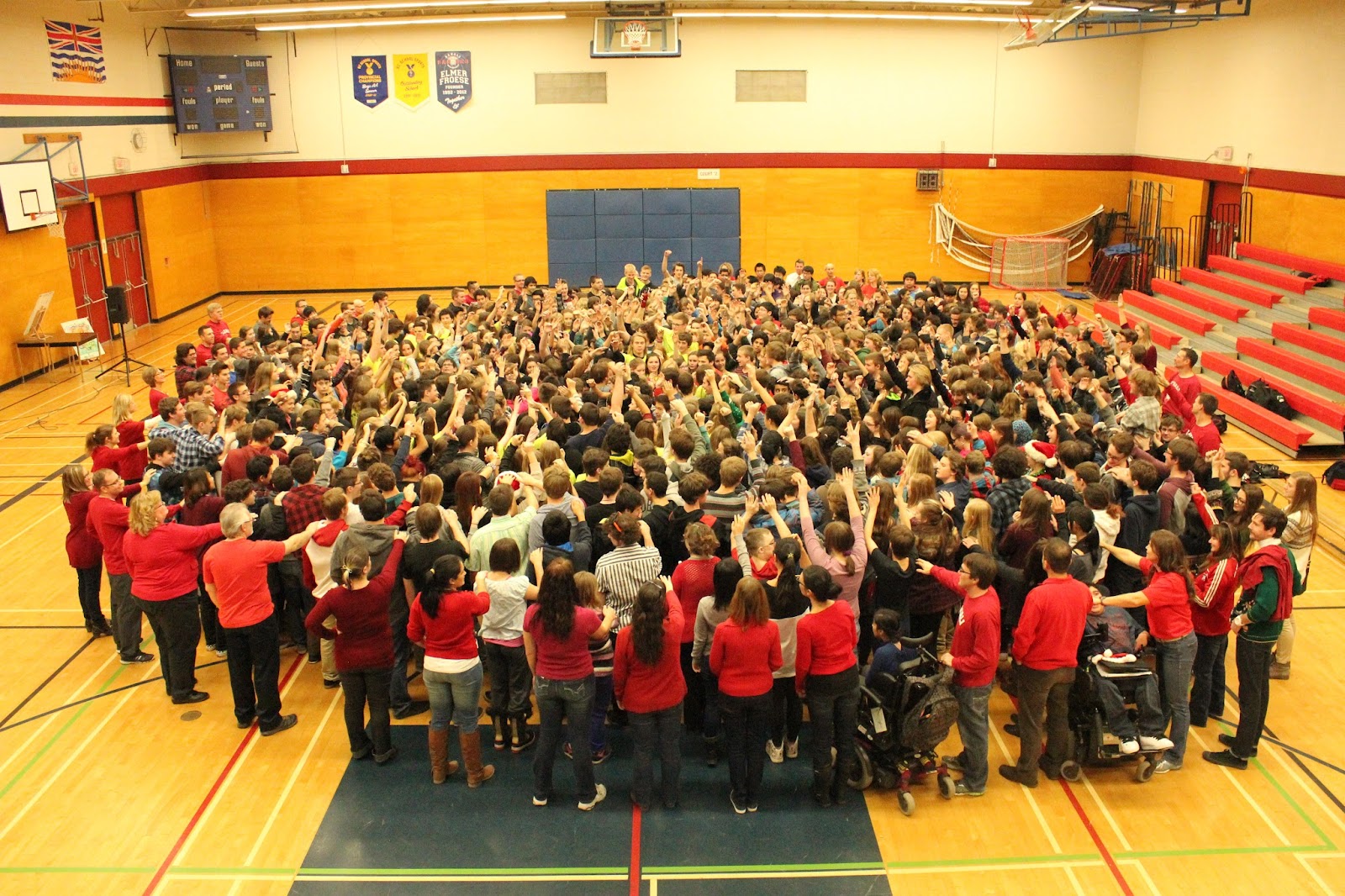
The hard work of our staff and students culminated in our first ever "CCR Attributes Assembly".  I won't lie, I was tremendously nervous.  Usually, assemblies were something to do with spirit, pep rallies, holiday celebrations, or messages from the community.  But this assembly concept was totally different, unique, and untested.  As well, while I was doing the introductory segment of the assembly, the rest of the staff had self-organized into three attribute groups that all had equal (and equally as vital) pieces in the show.  While I had helped with providing a framework for the other parts and our kids had 'tuned' them,  I had not actually seen what the groups were going to do.  Not to mention, each of them had a physical task for kids and staff to do that would reinforce the importance of our attributes. Inasmuch as I had referenced innovator Guy Kawasaki and his "don't worry, be crappy" mantra, and had told our staff we needed to get on with it, this was getting a bit crazy.  It was all on the line in front of 775 kids!  We couldn't walk away from this New Year's resolution--aka. #thisishappening

Together - Attributes.jpg
Our culminating symbol for resilience--WE will do this TOGETHER.
...and it all came together.  The whole school came together because we all did it together, for each other and in front of each other.  And it was awesome.

This process has made me question what authentic accountability really means.  As a staff, a lead team, and a project-tuning team, we were accountable to each other.  We were accountable to a highly visible product and a large and interested group.  But there were no grades.  No percentages.  No rubric.  There was no one giving us a thumbs up or a thumbs down.  There was just our own sense of pride in doing our best work for each other and for an audience because they were there, and they would be watching us.

We will continue to make ourselves accountable to each other, to our students and to our parents.  As much as we co-created this assembly to promote our attributes, to get feedback about these attributes, and to find out where our students and staff wanted to get started with these attributes, we also are creating our plan to develop these attributes that we will project tune with another group of students and parents so we can make our vision of a graduate become a reality for every one of our students.  And by creating our own authentic accountability checkpoints to eachother and to our community, we can avoid CCR becoming little more than a New Year's Resolution and keep ourselves on track to achieve our goal of producing graduates that are creative, collaborative, and resilient.

Sunday, March 3, 2013

The Guilt From Blogging Less

This week, I read a post by colleague and friend George Couros that really struck a chord with me.  In his blog, George wrote:

"Sometimes I wish that I had more great ideas. I wonder when an awesome idea will pop into my head or I will be inspired and I can share it with our staff and get them really excited about some new learning that can happen in their classrooms. Lately though, it just doesn’t seem the wheel are turning and I am starting to wonder why. I know that I have helped to push some great learning initiatives within our school division, but it doesn’t seem that there have been any new ones coming from my office lately."

For me, this hit the nail on the head.  I do my best to stay current with what is going on in the educational world:  I read articles each day, comment on blogs, try to collaborate with colleagues as often as I can, and put on PD sessions and attend conferences every few months.  But lately, much like George has alluded to, I feel like I have 'run out' of things to share.

Several months ago, I wrote a post called "Do What Should Done THEN tell" in which I wrote about my need to provide more practical applications in my blog:

"Each day, I read countless newspaper articles, impassioned posts, and convincing studies that shout out "we are failing children", "change the system", or "do something different".  These excellent resources are written by talented, skilled educators who work in the system today and clearly care deeply about students and student learning.  And to this end, I agree with all of them (or at least almost all of them) that I have read.  But then I think about Mom's comment in the Detroit Public Schools investigative report--"I know you care, now what are you doing to show it?".

This year, I am going to focus less on TELLING people how much I care about students, education and the need for educational reform to better meet the needs of student and teacher learners.  Instead, I am going to focus more on DOING things to make our school and current system of education better and then share with others."


And as much as we have been "doing things to make our school" better, I find myself feeling guilty that my blog has been relatively silent lately.  That according to the metric that I quoted for my blog above, that I am not being creative and innovative enough at our school that I feel like there is something new and practical to share.  Rather than blogging excitedly twice per week about the new and exciting things that we are doing at our school, I find that I am blogging once every couple of weeks, and reaching to do even that.

After beating myself up about this for quite a while, I am coming to grips with the fact that it's OK just to try to make what it is that you are doing BETTER.  That everything that you do doesn't have to be new.  That reflecting on what you are doing is likely not as 'glamourous' and 'share-worthy' as when you begin implementing something new and innovative. But while not as 'glamourous', reflection on what you are doing and tweaking things to make them more functional and effective in improving student and educator achievement is likely just as (if not more) important.

This year we have changed our staff meeting format and are constantly looking for ways to make staff meetings more interactive for our staff by altering our collegial conversation topic voting format.  One of the topics that we will be discussing in the near future is the effective use of cell phones for learning in classrooms:  some of our staff members are expressing some concerns with how they are currently being used.  We sent a team to the Professional Learning Communities Summit in February to create more eyes to critically examine our collaboration and intervention strategies along with surveying our staff so that we can tweak them at our next staff meeting. We changed the format of our SMART goal template so it more accurately describes the progress that our departments are making towards their goals.  Our library looks like a construction zone because we are coming close to our its being transformed into a Learning Hub.  Our student wifi capacity has been increased and changed to a more 'hotel-like' feel so more students can use it. And I am hopeful that our District's application to Instructional Rounds at Harvard will be successful.

However, none of these things are particularly 'new'.  Yet we continuously tinker.

I still struggle with this odd feeling of guilt for blogging less, but I hope that it is because we are reflecting more.

Do others struggle with this feeling?


Tuesday, February 8, 2011

I like making people mad.

"You pissed me off last night."

"Why is that?"

"Because I actually went home and tried Twitter."

Right now, as the Principal at my school, I spend a great deal of thinking about the use of technology and web tools in education.  I have a great support mechanism in my outstanding School Improvement Leader, Blake Buemann.  At least three or four times a week, we bounce ideas off each other around web tools, applying them to our school, devising methods to demonstrate them to our staff, and finding ways to have these tools help us engage kids or involve parents.  Really and truly, it often devolves into us shaking our heads at the amazing and limitless tools that are available and ways that they can be applied to the classroom.

Tonight I read an outstanding Blog Post on Connected Principals by Eric Juli called "I'm No Good at Technology", and it made me think about how we are trying to implement technology and the use of Web Tools at South Kamloops Secondary.  We have moved a long way in the past few months, and I think it is boiling down to a couple of elements--role modeling and persistence.

Five years ago when I came to South Kam, the technology that was available to our teachers was sorely lacking.  We had antiquated computer labs populated by throwback "Computers for Schools" donated from local businesses who no longer wanted them.  We had no common email system, and most teachers did not use email at school.  Some teachers had electronic grading programs, others used pencil and paper and then entered them into our student management system.  That was just five years ago.  And it made me mad.

So every time there was a pilot project around technology in our district, I volunteered our school.  Thin client, linux-based computers with open source software?  Count us in.  Wouldn't mind a school piloting Zimbra (open source email), how about South Kam.  Thinking about wireless in the district, sign us up, we'll pilot it.  Want to set up a learning lab in the library, my librarian is all over it.  We are now completely wireless at our school, with a fiber backbone and separate ports for our staff, for our students, and for the public.  We are linux-based, and run on open source software, including our central email system.  We have 42 digital projectors in our school.  We have a learning lab with Smart Technology in it, and a couple of classrooms that have Smartboards as well.  And we will get more.  Our PAC is right on board with us.  We have been persistent.

But getting technology into the building is just the start, isn't it?  I have heard of schools and districts that "buy all of their kids laptops" or "get all of their teachers tablets or iPads".  My question always is, "Why?".  Just getting people technology does not help people use technology to improve instruction or engage students.  It needs to be role-modeled. 

After going to the 21st Century Learning Conference in Chicago in October, my School Improvement Leader and I decided to go for it.  We got Twitter Accounts. We downloaded Tweetdeck.  We began working in Google Docs.  Diigo toolbars adorned our browsers. We converted our school improvement plan from paper to web using Blogger, and so was born our School Improvement Plan Blog.  We began planning every staff meeting with the idea of engaging our staff with strategies that they could use in their classrooms to engage kids, and not just with technology  At our staff meeting in November, I spent a large portion of the meeting showing examples of the power of social media.  In December,we had our entire high school staff work on a blog, and collaborate on a school improvement topic using Google Docs.  We developed a communications protocol for our community using Twitter, Facebook, Buzz, Tumblr, and other tools. At our staff meeting last night, I gave a demonstration of Tweetdeck, and how it can be an unbelievable stream of resources for teachers.  And I was lucky enough to be asked to do a Webcast describing our school improvement blog last night for Parents as Partners.  We are role modeling.  We are being persistent.  And it is making a difference. 

We have a number of our staff members using blogs for their courses, and putting their courses on Moodle.  We have our math teachers using tablets so they can upload lessons to the internet. My Foods teacher asked if I knew any hashtags for Home Economics.  I found our art teacher signing up for a tumblr account during lunch.  And the engagement that we have had around our school improvement plan has been unbelievable--staff, students and parents are in!

But best of all, one of my most veteran teachers came into my office this morning after the staff meeting last night and said:

"You pissed me off last night."

"Why is that?", I asked.

"Because I actually went home and tried Twitter."

Role-modeling and persistence.  They are making difference.


Cool.