Showing posts with label connected. Show all posts

Tuesday, January 12, 2016

Learning Can't Wait


The more I think about new initiatives and changing education, the more I believe that Dan Weiden got it right.

In August of 1988, when there would have been a high degree of likelihood that I was sporting acid wash jeans and a styled perm, the aforementioned Mr. Weiden coined a phrase in his work as a Portland advertising executive.  You might have heard of it...

"Just Do It"

From that point forward, the words "Just Do It" became not only the key branding phrase for Nike, but a part of the English lexicon forever more.  When you close your eyes and say those words, you can probably envision the font in which the phrase was written and the little black Swoosh right below it.  How many t-shirts did we own with those three words emblazoned somewhere on the front or back?

I believe that now more than ever in education, we need to adopt a "Just Do It" philosophy.   For a variety of reasons too numerous to list, we seem to be suffering from an insatiable desire to ensure that any new initiative, program, or philosophy that we are even thinking about trying is both foolproof and battle-tested to a level of imperviability that rivals kevlar or kryptonite.  We feel like we need to find the correct timing in the future for us to unveil a new idea so that we maximize the 'wow factor' and minimize negative exposure.  Or that we must determine the exact point at which the percentage of supporters is likely to outweigh the naysayers by a wide enough margin.  Or to discover the moment during the year when people have the correct mix of enthusiasm, energy, and separation between writing report cards, submitting improvement plans, doing budgets, getting ready for standardized tests, holidays, and the last full moon. And please make sure it falls in the correct block during the rotation, because we have hit period four three times in the last four months.

My point?  People are always busy--in fact, we can't even say we are busy anymore, we have to out-do each other with our descriptors of busy.  Wildly busy.  Crazy busy.  INSANELY busy. It seems the more bleary-eyed, disheveled and haggard that we can look while doing our work and the closer we can get to the lunatic fringe of frenetic activity, the greater status we feel we have with our colleagues.  Schools are busy places; they should be.  Schools and classrooms should be thriving, and filled with meaningful and significant events that are rich for students and educators alike--they should be insanely busy.  Budgets always need to be managed, staffing needs to be done, exams need to be administered, and there are always projects to finish and deadlines to meet.  And when we throw all of this stuff into our Google Calendars, one fact becomes clear and immutable:  there is no perfect time to start anything.

But there is one other clear and immutable fact, and it comes from Saul Kaplan (@skap5), founder and "Chief Catalyst" (love that) at the Business Innovation Factory in Providence, RI.  He said something that resonated with me (especially as a father of two young children in the school system) when I was at the BIF Conference last September:

A decade is a terrible thing to waste.


Wow.  How right is that.  He and his team at the Business Innovation Factory pleaded with the organizations they work with to "get off of the white board and on to the real world".  To "go from napkin-sketch to prototype". To "stop studying it and just do it".


A couple of years ago, I was having lunch with colleague and friend Chris Kennedy (@chrkennedy), the highly-regarded and forward-thinking Superintendent of the West Vancouver School District. One of the things that I always have admired about Chris is the fact that he still gets into classrooms and teaches students about digital literacy and future skills.  So I asked him "How do you do it?  How do you find the time to get into classrooms when you are the Superintendent?".  He looked at me and said "I want to be in classrooms with students, so I make time for it.  It's a choice.".

#simple

But let's quickly dispense with the false dichotomies that inevitably will follow.  So does that mean that we should do everything?  No.

Say 'yes' to everything?  Nope.

Chase after every initiative?  No, that would be inefficient, irresponsible, unsustainable, and make us INSANELY busy.

We have to work within the box that we live, and manage the parameters that we have.  There is likely no more money (my next post will be about how to create money out of thin air, BTW).  There are only 24 hours in the day.  These are obstacles that we can't push to the side--we must embrace them! (Sounds a lot like 'Frugal Innovation')

But Chris's comment underscores something that is paramount for me:  we must choose what we want to do and DO it.  And I believe that we help ourselves to do this by following four steps.
What will students say, do  and write?


  1. Co-create a vision for your learner (this could be a student, teacher, support staff member, administrator, or even a parent in the community)
  2. Co-define what they would be saying, doing, or producing when they are demonstrating this vision (as in this image from an improvement plan that gets right down to specifics.)
  3. Determine your learner's current reality through observations by a team of educators that provide specific, descriptive, and non-judgmental feedback relative to your vision using a network-based approach like Instructional Rounds (and come to the Rounds Institute in Kamloops in April with dozens of other fantastic educators!)
  4. Co-design potential solutions knowing that while they might not be perfect and they might not work the way you thought you would, that you will learn about the learning taking place in your building, regardless.
  5. Follow what Saul Kaplan says: "get off of the white board and on to the real world", "go from napkin-sketch to prototype", and to "stop studying it and just do it".

Because learning can't wait, our students can't wait, and neither can we.

Thursday, October 30, 2014

Connecting the Disconnected


This past weekend, I was lucky enough to go to the 21st Century Learning conference in Vancouver, BC. I was particularly jazzed to see two presenters; Will Richardson and my pal Bill Ferriter have both impacted my thinking significantly since I added them to my personal learning network.  And while their methods were different, both Will and Bill had some common messages in terms of the learning that students are doing in schools today and how (or if?) it relates to the types of skills that students will need in the hyper-connected environment that we live in today.  They pushed the group to think about how we 'connect the disconnected' by highlighting a some points that resonated with me:

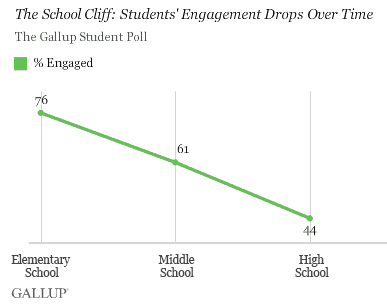
As kids move through the K-12 system, they become less and less engaged in their schooling.
And while Sir Ken Robinson and others have affirmed this fact for us, both Will and Bill quoted the 2012 Gallup Poll Student poll (of more than 500,000 students) that showed the percentage of students that described themselves as being engaged in their studies dropping by over 30 points as they move from elementary to high school.  Each of them challenged the group:  are we comfortable with this?   Are we willing to confront this?  And for me personally, no matter how many times I hear statistics like this, I still cringe and think about what we can do differently.


We need to give students meaningful work
Students want to do something that makes a difference.  They want to help others.  The Kiva Club developed by Bill Ferriter's Grade 6 that raises money to provide microloans for impoverished individuals and the #sugarkills blog to fight obesity that his students created are sustained by students who are willing to give up their own time to help others that they have never and will likely never meet.  But worksheets are not meaningful.  Memorizing answers to questions that we can simply search for using Google are not meaningful. Right now?  Meaningful.  There is a chance you might need to know this at some point in your life?  Well, not so much.

Classrooms need to be places to make connections, not disconnect
We can no longer ask students to disconnect from the hyperlinked, information-saturated, teacher-laden world (yes, teacher-laden--because students have the ability to learn so much from virtual and face-to-face peers and adults in their world who have loads of expertise in different areas) where they learn for two-thirds of their day.  As Will Richardson said, we need to completely wipe that scarcity-inspired thought from our minds.  We have to.  Because if we think that students are going to settle for anything less than that, they won't (and they aren't).

We MUST have a clear vision
We don't begin with 'all of our students are going to blog'.  Or 'each of our classrooms will have Smartboards'.  Or spending a billion dollars on iPads (as the LAUSD did, with decidedly 'mixed' results).  We don't begin with the mindset that 'technology engages kids'.  We begin with a vision of the attributes that we want for our children (like the excellent work being done in the Kelowna School District and Farmington High School), and then use these attributes to guide our decisions, our structures, our PD, and our approaches to student learning in our classrooms.  (To see a way to get started with your staff, check out this fun way to begin the conversation about developing a mission in schools.)

So, I know what you are thinking:

"Ya ya ya...we know all this stuff, but how do we do it?

Both Will and Bill were very clear--in British Columbia, we enjoy freedoms in our curriculum that simply do not exist in most jurisdictions across North America.  And they were also very clear in their plea for us as educators to take advantage of this curricular latitude to create the learning environments that children need.  And finally, they both told the participants one thing:  get started.  Now.  The urgency lies in the idea that every day the world is changing, so we have a moral imperative to change the environment that students learn in for six hours per day to more closely mirror the world they live in for the other eighteen hours.
So at Sa-Hali Secondary, what are we going to do as a result of the message that I heard this weekend?

  1. We are going to involve our students in the development of and execution of a process that will both highlight our work on attributes to this point and involve them in the selection and definition of these attributes.  We will use the High Tech High Tuning Protocol to develop this process starting with the question "How will we involve our school community in the development of our list of attributes so that they are in the heads, hearts and hands of students, staff and the community?"
  2. We are going to use these attributes as a start point for the process of Instructional Rounds in our school.  We will reflect on our school through the lens of the attributes that we feel are important, and determine how we can scale the innovative practices that are currently happening in our school through making the walls of our classroom permeable to our staff and to others.
  3. We are going to make student and adult learning visible at our school through the development of a school-wide digital portfolio.  Our staff and myself will learn the process of developing digital portfolios by creating a three-dimensional digital portfolio that will serve as our school improvement plan.  We will do this so that we can learn by doing, and model the creation of a positive digital footprint that will allow students to truly demonstrate what we know.  This will allow us to prepare students to develop a capstone project as a culmination of their K-12 learning (a great example of Capstone Projects can be seen at Chris Lehmann's Science Leadership Academy) that they can take away to support them in what they choose to do after they leave us.
  4. On a personal note, I am going to start a Kiva project at our school.  I don't know how this is going to work yet, but I am confident that like every school we have the students who want to make a difference in the lives of others.

Perhaps these are lofty goals, but I am articulating them here so I can hold myself to them.  I agree with Will and Bill, we can change how we engage and empower students in their education, and we need to start. Now.

So we will!  Stay tuned.