Showing posts with label strategies. Show all posts

Tuesday, February 2, 2016

The Teaching Fab Lab


"We need more risk-takers!"

"We need to build a culture that not only accepts failure, it rewards it."

"I just want people to take a few chances around here.  You know, to try some new things."

In my position as District Principal of Innovation, I am constantly hearing these sorts of expressions from educators throughout the system about their students, their colleagues, and the organizations where they work.  If you spend a even a few minutes on social media, you will find tweets, Facebook links, LinkedIn posts and blogs talking about the importance of developing a mindset of "failing fast and often", "doing then knowing", or "iterate, iterate, and then iterate".  Are you puffing your chest out about having a Learning Commons?  Be careful, someone might walk by you and whisper "That is so 2010.". People are talking about maker spaces, hacker spaces, green screen rooms, and think tanks.   And let's be real, in my visits to schools and districts in British Columbia, I have yet to hear someone say "we need to be less innovative".

But what are we actually doing to develop and scale innovative practices?  Make no mistake, we would be hard-pressed to find a school or district that doesn't have exciting and interesting things happening, at least in small pockets. But we often are so tunneled into the day-to-day goings-on in our districts, in our schools, and in our classrooms that if someone were to ask us about an innovation at a neighboring school or nearby district, we most likely would be unable to answer.

And I get it!  Everyone is busy.  Coordinating schedules can be challenging.  Releasing people to be able to visit other schools is expensive, and sending them to other districts even more so.

In his book The Business Model Innovation Factory, Saul Kaplan talks about creating "the adjacent possible", a place in an organization where new ideas and service models can be live-tested in a real environment with actual clients.  This 'adjacent possible' environment still has the benefits of being a part of the larger organization, and is able to take advantage of the infrastructure and economies of scale that the company has to offer, but it is able to test out radically different models and ideas in a low-risk, high-reality setting with the goal of informing future practice.  It is a recipe for success, and without it, companies who focus solely on their current business model tend to fail miserably, or "get Netflixed", as Blockbuster Video found out.  Those who have their current model and think about new models by creating "the adjacent possible" are the organizations that will remain nimble, responsive and relevant as the needs of their clients change.

Just like the needs of our students are changing.

As a result, I believe we must to create the "adjacent possible" in education. In every school and district.  We could call it "The Teaching Fab Lab".  And it would be right down the hallway.

Any teacher in the school could book into the Fab Lab, and once in there, they would be free to test out new and interesting teaching practices, knowing that they might work, and knowing they might not.  Maybe for a day.  Maybe for a week.  Or longer.  And fellow educators would not have to take release days and travel hundreds of miles to see the inquiry process in action, or Project-Based Learning, or genius hour, or whatever was on display in the Fab Lab.  They could just wander down the hall and have a look!  They could ask their administrator or another teacher to watch their class for a few minutes or a period, and even jump in an co-teach for a bit with the Fab Lab host, just to get a feel for the activity.

Naysayers might be jumping up and down right now yelling "People can't just teach however they want!", or "But what if it doesn't work?", or "We can't waste time, we have too much content to cover!".  I guess so, but I am thinking that we could respond by saying things like

"We need more risk-takers!"

"We need to build a culture that not only accepts failure, it rewards it."

"I just want people to take a few chances around here.  You know, to try some new things."

I am going to do some more digging into this.  If you have examples of these in your schools or districts, please comment so I can come and visit!

Thursday, October 30, 2014

Connecting the Disconnected


This past weekend, I was lucky enough to go to the 21st Century Learning conference in Vancouver, BC. I was particularly jazzed to see two presenters; Will Richardson and my pal Bill Ferriter have both impacted my thinking significantly since I added them to my personal learning network.  And while their methods were different, both Will and Bill had some common messages in terms of the learning that students are doing in schools today and how (or if?) it relates to the types of skills that students will need in the hyper-connected environment that we live in today.  They pushed the group to think about how we 'connect the disconnected' by highlighting a some points that resonated with me:

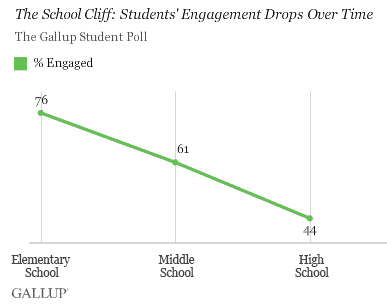
As kids move through the K-12 system, they become less and less engaged in their schooling.
And while Sir Ken Robinson and others have affirmed this fact for us, both Will and Bill quoted the 2012 Gallup Poll Student poll (of more than 500,000 students) that showed the percentage of students that described themselves as being engaged in their studies dropping by over 30 points as they move from elementary to high school.  Each of them challenged the group:  are we comfortable with this?   Are we willing to confront this?  And for me personally, no matter how many times I hear statistics like this, I still cringe and think about what we can do differently.


We need to give students meaningful work
Students want to do something that makes a difference.  They want to help others.  The Kiva Club developed by Bill Ferriter's Grade 6 that raises money to provide microloans for impoverished individuals and the #sugarkills blog to fight obesity that his students created are sustained by students who are willing to give up their own time to help others that they have never and will likely never meet.  But worksheets are not meaningful.  Memorizing answers to questions that we can simply search for using Google are not meaningful. Right now?  Meaningful.  There is a chance you might need to know this at some point in your life?  Well, not so much.

Classrooms need to be places to make connections, not disconnect
We can no longer ask students to disconnect from the hyperlinked, information-saturated, teacher-laden world (yes, teacher-laden--because students have the ability to learn so much from virtual and face-to-face peers and adults in their world who have loads of expertise in different areas) where they learn for two-thirds of their day.  As Will Richardson said, we need to completely wipe that scarcity-inspired thought from our minds.  We have to.  Because if we think that students are going to settle for anything less than that, they won't (and they aren't).

We MUST have a clear vision
We don't begin with 'all of our students are going to blog'.  Or 'each of our classrooms will have Smartboards'.  Or spending a billion dollars on iPads (as the LAUSD did, with decidedly 'mixed' results).  We don't begin with the mindset that 'technology engages kids'.  We begin with a vision of the attributes that we want for our children (like the excellent work being done in the Kelowna School District and Farmington High School), and then use these attributes to guide our decisions, our structures, our PD, and our approaches to student learning in our classrooms.  (To see a way to get started with your staff, check out this fun way to begin the conversation about developing a mission in schools.)

So, I know what you are thinking:

"Ya ya ya...we know all this stuff, but how do we do it?

Both Will and Bill were very clear--in British Columbia, we enjoy freedoms in our curriculum that simply do not exist in most jurisdictions across North America.  And they were also very clear in their plea for us as educators to take advantage of this curricular latitude to create the learning environments that children need.  And finally, they both told the participants one thing:  get started.  Now.  The urgency lies in the idea that every day the world is changing, so we have a moral imperative to change the environment that students learn in for six hours per day to more closely mirror the world they live in for the other eighteen hours.
So at Sa-Hali Secondary, what are we going to do as a result of the message that I heard this weekend?

  1. We are going to involve our students in the development of and execution of a process that will both highlight our work on attributes to this point and involve them in the selection and definition of these attributes.  We will use the High Tech High Tuning Protocol to develop this process starting with the question "How will we involve our school community in the development of our list of attributes so that they are in the heads, hearts and hands of students, staff and the community?"
  2. We are going to use these attributes as a start point for the process of Instructional Rounds in our school.  We will reflect on our school through the lens of the attributes that we feel are important, and determine how we can scale the innovative practices that are currently happening in our school through making the walls of our classroom permeable to our staff and to others.
  3. We are going to make student and adult learning visible at our school through the development of a school-wide digital portfolio.  Our staff and myself will learn the process of developing digital portfolios by creating a three-dimensional digital portfolio that will serve as our school improvement plan.  We will do this so that we can learn by doing, and model the creation of a positive digital footprint that will allow students to truly demonstrate what we know.  This will allow us to prepare students to develop a capstone project as a culmination of their K-12 learning (a great example of Capstone Projects can be seen at Chris Lehmann's Science Leadership Academy) that they can take away to support them in what they choose to do after they leave us.
  4. On a personal note, I am going to start a Kiva project at our school.  I don't know how this is going to work yet, but I am confident that like every school we have the students who want to make a difference in the lives of others.

Perhaps these are lofty goals, but I am articulating them here so I can hold myself to them.  I agree with Will and Bill, we can change how we engage and empower students in their education, and we need to start. Now.

So we will!  Stay tuned.