Wednesday, October 23, 2013

Faster Is Not Always Better

A few weeks ago, I wrote a post called "Inclusive Staff Meetings" - a description of how we were deliberately going slowly in our efforts to create meaningful, and engaging staff meetings that encouraged risk-taking through a safe and collegial environment.  From that post:

"...we worked again in small groups on a Google Doc called "Staff Meeting Commitment Brainstorming" in which our entire staff worked together to draft ideas for commitments to make our faculty meetings safe for all of us.  A number of faculty members had never worked simultaneously and collaboratively on a digital document such as this in such a large group, and it was amazing to see every staff member engaged in meaningful dialogue with their peers...

Early in my career, in the interests of not wanting to 'take too much time on this stuff', I would have taken all of the information myself and tried to sort, classify, paraphrase, and make inferences in a process to pare down the information we had gathered into palatable chunks for the staff. At that point, I would have moved the commitments in a direction that I felt we needed to go, truncated the whole exercise, and moved on.  Without malice and in the interests of time, I would have inadvertently hi-jacked the process.

Like any school, we have hundreds of years of experience on our staff.  Our Coordinators are highly motivated, creative problem-seekers and solvers that are tremendously invested in their students, their classrooms, and their colleagues.  So regardless of how long the process takes, we will involve our entire staff in making a set of commitments that will allow everyone to be a contributing, engaged and valued staff member during our faculty meetings.  The information that we collected will come to our Coordinators, who will help to design an exercise with all of the feedback we collected that
  • requires the engagement of each staff member 
  • models the use of higher order critical thinking skills for our staff (interpretation, prediction, selection, synthesis, etc) in an exercise they can adapt and apply to their classes 
  • leads to the implementation of a tangible product (such as the chart from our Social Justice class) that is reflective of each of our voices, and subsequently guides us for all of our future staff meetings
  • has them touch a piece of technology so that the exercise can be as efficient and replicated/archived (in our Sa-Hali Educational Sandbox, which we just created yesterday!) for future use in classrooms or collaborative meetings."
As a result of our work at that initial staff meeting, our Coordinator Group put together just such an activity--the 10 Dot Gallery Walk--which allowed our staff to interact with each other around the ideas for staff meetings that we had collected.  As a group, our staff were able to prioritize the suggestions and ideas in front of them for creating the norms of an inclusive staff meeting.  It looked like this:
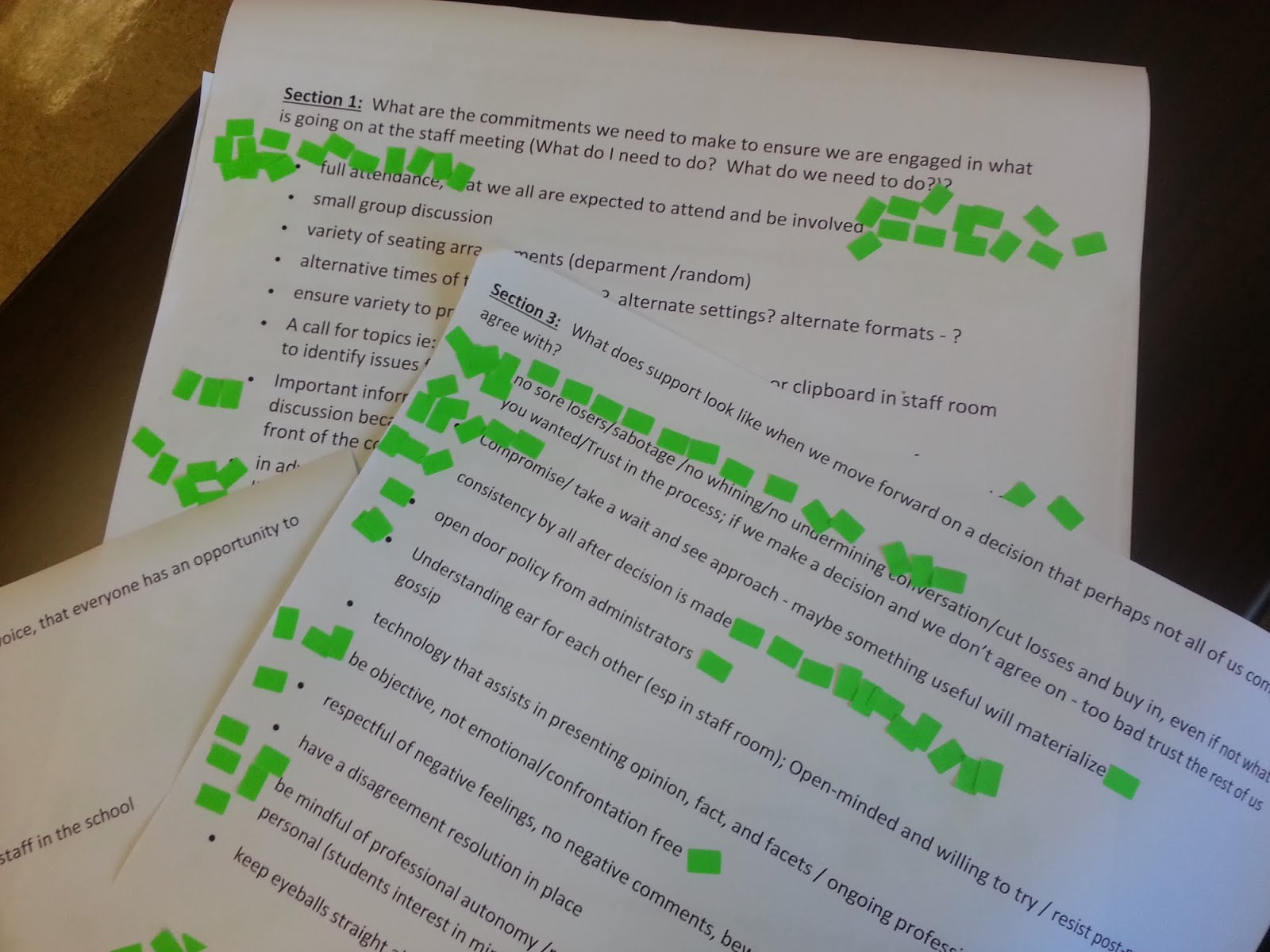


The engagement of the staff in this activity was notable--people were asking each other for clarification, looking for similar threads on other sheets, and truly being thoughtful in the placement of their 'priority dots'.  And in the end, we got a product that gave us a distinct visual in terms of where the priorities of our staff truly were.  

But that wasn't enough.  

In order to continue to make this process authentic, we needed to take these priorities and craft them into a concise and easily articulated list of commitments that reflected the views of the group.  Again, it would be quick and easy for me to just put these into words that I thought represented the views of the group, but that would not be in the spirit of the activity (nor would it be terribly accurate).  So, as a Coordinator Group with representatives from each department, we began to sort and collect similar terms that were the highest priority for staff (denoted by the dots) and find themes.  The group came up with three temporal themes for staff meetings--Pre-Meeting, During the Meeting, and After the Meeting. Then, I became the scribe, the group became 10 'muses', and we thought with our mouths, debated, wordsmith-ed, re-wrote, and teased out 10 commitments.  They look like this: 

Pre- Meeting
  • we will submit items to the agenda, read the agenda and supporting documents prior to the staff meeting
  • we will attend the meeting and be engaged and involved
  • we will clear purpose and agenda to each staff meeting
  • we will have food for the meeting

During the Meeting
  • we will maintain a light, positive tone with a spirit of collegiality
  • we will come to the meeting with an open mind and consider new ideas and points of view
  • we will have the parameters of the decision-making process will be clearly articulated prior to the discussion
  • we will respect that there may be a need for additional time/input about a decision
  • we will use a variety of creative solutions (ie. anonymous votes, small group forums) to ensure each staff member has a voice

After the Meeting

  • we will trust in our collegial decision-making process
  • We will honor the decision made at the meeting and move forward!

But we are not done yet!  At our November staff meeting, each member of the group will present one of these commitments to the staff and talk them through how we got to that particular commitment from the original, gallery-walk document.  Once we have done this for each of the bullets above, we will ask the entire staff for any further refinements that need to be made.  At the December staff meeting, we will unveil our commitments to each other so that staff meetings actually honor the vision that we have collectively articulated.

From the outside, what we have done here might seem like a long and arduous process.  I guess I could have just made up some commitments and said this is what I want, what I expect.  Or I could have grabbed a list of norms from a book or article, and had us modify them to work for us.  That would have been much faster.

But this is not a race.  With something as important as how we will work together in a large group setting, faster is not always better.

I think it has been time well spent.  The product that we are creating is authentic and representative of each of us:  through the tasks that we have done, we have been required to participate in the process, we modeled and used higher-order thinking skills, we are implementing a tangible product, and we have even touched a technology that we can use in our classes in the process.

Sounds a lot like what we set out to do in the first place, and I look forward to the final product.  I am very proud of our teachers for working through this--congratulations to our staff!


- cross-posted in the Sa-Hali Educational Sandbox


Tuesday, October 8, 2013

Engaging Our Faculty in PRTI

Over the last few weeks, our staff has been working feverishly to create structures that enhance and ensure adult and student learning.  We are refining our collaborative commitments to one another to ensure positive communication, problem discovery and risk-taking in our whole staff and collaborative meetings.  We have designed and begun to implement a collaborative model that enables self-organized learning within a framework of defining guaranteed curricula and recognized struggle points.  And we have done all of this within the context of a collectively defined vision that has been initially formulated by our teachers, but will also be co-created by our parents and our student body. 

As we are doing this while the school year is in progress, suffice it to say the first five weeks have been crazy.  Crazy good.

But this afternoon at our faculty meeting, we had more work to do in terms of the interventions that we have in place to ensure student learning at our school. Over the course of last year, Sa-Hali made a commitment to Pyramid Response to Intervention. As we know, PRTI strives to blur the lines between general and special education to create a systematic means to serve all students, regardless of whether they are learners who struggle significantly or just need some minor 'fine-tuning' to get back on track. And while we have created our CORE team and numerous structures to support student learning through the lens of PRTI, we realized as a group at our Student Services collaborative team meeting last Wednesday (which I was lucky enough to be a part of) that we needed to find a way to familiarize our staff with these structures in such a way that they would be comfortable using them in the future.  

Hmmm. How about a flashy Powerpoint with lots of bullets and animations describing each of the structures that we have at our school followed by a handout at the end that the faculty could take with them?

Yawn. Paper airplane coming up. The design team scuttled that thought in a hurry. "We tried that once, remember?"

Our design team wanted to stay aligned with our guiding principles for faculty meetings around staff engagement and adult learning (from a post early last month called "Inclusive Staff Meetings"), which meant co-creating an activity that:
  • requires the engagement of each staff member 
  • models the use of higher order critical thinking skills for our staff (interpretation, prediction, selection, synthesis, etc) in an exercise they can adapt and apply to their classes 
  • leads to the implementation of a tangible product (such as the chart from our Social Justice class) that is reflective of each of our voices, and subsequently guides us for all of our future staff meetings.
So, in the span of a 45 minute collaborative meeting (and an incredible effort from our Student Services Coordinator and her staff leading up to our faculty meeting), the team created an activity that looked like this (yes, these are the actual handouts below--cool).


  • our staff was divided into groups of 5-6 and given five blank "Scenario Sheets"--these sheets had a large space for "Teacher Interventions" (Tier 1) interventions for group brainstorming plus a blank flowchart below
  • each of our twelve Tier 2 and Tier 3 interventions with detailed descriptions were put on to different colors of paper, and each group member given two of these to role play for the other group members
  • the staff was presented with 5 "Student Scenarios" that described fictitious student situations of varying levels of complexity -- things such as

  • in their groups, teachers (equipped with their roles) brainstormed their Tier 1 responses, shared their roles with the group, and evaluated the scenario, and then assessed which other interventions would be most appropriate to help the fictitious student in question as well as the sequence in which they would be enacted.
  • groups then had to report out to the large group so that we could compare solutions, clarify any questions about our intervention mechanisms, and suggest alterations.
I was stunned by the response of the staff to this exercise. Because of the structure of the exercise that our Student Services team presented, I saw 40 professionals dig in, ask questions, respectfully challenge the responses of members of their own groups and other groups, wave the activity leaders off and shout "we need more time with this one", flip through the interventions and shake their heads while saying things like "we don't need to go to that level yet" and "we need to make a connection with kids like this". It was awesome.

And at the end of the exercise, our amazing Student Services Coordinator collected all of the scenario sheets from each of the groups so that she and the rest of the Student Services team could analyze each of the responses to see if there were any gaps that she needed to fill with the staff during their next collaborative meeting. She also wanted to use the results to shape and tailor our PRTI flowchart to ensure the staff could efficiently use the interventions available to them for our students.  

But that's not all.

In the spirit of reflection, as a staff, we looked at the activity that we did. Much like in the past, we could have done a handout. We could have done a 'think-pair share'. But there would have been little guarantee of learning. As a group, we analyzed this PRTI task through the lens of what we were 'saying, doing, and writing' so that our group could 'learn the work by doing the work'.

Our Technology Coordinator and English Coordinator are well-versed in Photoshop for poster creation. With their assistance, our school will design and implement a less-conventional, student-appealing PRTI graphic complete with terms in 'kid-speak' that will be posted in each classroom (and on our webpage). This will allow our students, parents and staff to know each of the supports that will be enacted should students struggle with the outcomes in our courses.

This process took (and will continue to take) a great deal of effort from numerous people on a variety of fronts. However, the very thrust of PRTI is to blur the lines between special services and the regular classroom. By having the entire faculty co-create our PRTI model through an collaboratively developed "case-study"-style activity that we found to require adult participation and learning through our task analysis, I believe we will have significantly more buy-in than we would have by simply listing our interventions on a Powerpoint and hoping people would utilize them.

If you have ideas or suggestions on how we can improve this process at our school, please comment and let us know!


Saturday, September 28, 2013

A Fun Method to Create a Vision For Schools


Yesterday, we had our annual September Professional Development day with my staff at Sa-Hali.  It was the culmination of a few weeks of planning by the large and dedicated bunch known as our PD committee, and each of us was excited to see how the day would play out with our staff.   Having gone through and led visioning activities before, I feel that activities such as these need to be approached very carefully.  When done without thoughtful consideration and planning, vision exercises can become nebulous, ethereal and, well, vision-less.  However, when done with a focus on engaging the participants in an exercise that is tangible and meaningful, visioning activities can lead to guiding principles that can set the course for the entire organization.

Or at least that's what I've heard.

However, there was just one tiny problem I was having heading into the planning of this day.  I wasn't totally sure how to do that.

But one thing that I was totally sure of--as a group, WE would know how to do that.

When the PD committee met, we decided we wanted to create activities for our staff that REQUIRED learning, and that REQUIRED their participation.  Not in a "thou shalt" way, but in a way that built on our theme for this year--we do things TOGETHER.  And suddenly it started to happen.

We started with our English Coordinator saying that we needed to do some team-building at the start.  Then another teacher said "How about a scavenger hunt?".  Our Technology Coordinator jumped in with "We need to keep them touching technology, so let's make it a QR code-based treasure hunt!".  A member of our Learning Assistance department chimed in and said "We want them to be creative, let's have them design a costume and team T-shirt!".

The juices were flowing.

We turned to visioning, and our Art teacher said "If we are going to create a vision, we need an authentic visual--let's make a life-sized "Sa-Hali Grad" with the body parts containing attributes that we want our students to be equipped with when they leave!"  But we needed to get people in the mindset, and another person suggested a YouTube video of something--I said how about watching Sir Ken Robinson and "Changing Educational Paradigms" while modelling a literacy strategy to ensure that participants would be engaged and have something to take away.  Our English Coordinator jumped back in and said "Speaking of a literacy strategies, how about a multi-perspective carousel activity where groups create those body parts filled with the attributes of a Sa-Hali grad?"  He then came up with some guiding questions...

  • What do we think employers want of our grads?
  • What do we think society wants of our grads?
  • What do we think post secondary programs want of our grads?
  • What kind of attributes and personal empowerment do we want them to have?

Wow.  This was getting really cool.

But I wanted to make sure that we didn't just leave with a picture, we needed to leave with a plan.  And we came up with an activity that allowed us to:
  • reflect on activities we do in our classrooms that require students to demonstrate these attributes
  • get specific with looking at the tasks that we felt required the demonstrate these attributes by describing what it looked like, sounded like, and felt like in descriptive (rather than inferential) terms
  • design and implement an activity that we could do to elicit these attributes from our students in each of our collaborative groups to bring back to the December staff meeting to share.

And so it came to be...

We worked with QR codes in our staff scavenger hunt (here is one of the sample clues)

We had unbelievable team building, tremendous creativity and a whole lotta laughs:


Utilized literacy strategies in our activities such as Save the Last Word and Multiple-Perspectives Carousel 

Designed a visual aide to guide us in terms of our vision of attributes that we want for our graduates.

We met as collaborative groups to design an activity that we could do to require students to demonstrate a positive attribute.


And, as challenge to myself, I created a video archive of our day with Movie Maker, just to see if I could do it while we were working (and over lunch).  I presented it to our faculty as a "Thanks for all of your hard work" at the end of the day--I hoped they enjoyed watching it as much as I loved making it.

In the end, while this format for beginning to develop a vision may not work for another school in its entirety, I believe the important elements of this day can be applied to any school situation. By using tasks that  
  • are co-created by numerous staff members;
  • are built intentionally to require participation of each of our colleagues;
  • are built specifically to require learning in a meaningful (and fun!) way through their design;
  • model ready-made literacy strategies that can be used in each of our classes tomorrow to engage our students;
we can meaningfully engage our faculty in vision development.  My evidence?  We now have built a collective vision.  We now have a document that will guide us to design and implement the tasks that require students to demonstrate the attributes that we want for our graduates as they cross the stage and graduate from our school.  

And we had a great day continuing our theme of "Working TOGETHER".  Is there anything better?


Tuesday, September 10, 2013

Inclusive Staff Meetings

This afternoon, we had our first 'official' faculty meeting with our staff at my new school, Sa-Hali Secondary School.  On Opening Day, we met briefly to discuss some technical tidbits to get the school up and running, but this was our first real chance to learn together as a large group.  I was quite excited, and a bit nervous as well:  I know that staff meetings can often be known as the rapid remedy for insomnia, and I was eager to ensure that our faculty meetings would not be similarly characterized.

Last year I wrote a post called "Owning Staff Meetings", a piece that I composed to challenge myself to create inquiry-based activities that would engage our staff in the co-creation of engaging staff meetings and model ideas that staff could use in their own classroom.  From that post:

"I wanted to create an inquiry activity that would allow our staff collaborate together to collectively come up with ideas on how to increase staff engagement.  There were a few reasons for us to do it this way:
  • We want to continue to have or staff learn different techniques to effectively engage their students in class discussions
  • We want to continue to expose our staff to collaborative technologies that maximize engagement and interactions between participants
  • We want to get authentic staff input
  • We really don't know the answers to the questions that we were asking our staff about making effective staff meetings for our staff."
After adopting this philosophy, I found that an inquiry-based approach was significantly more effective in increasing the number of interactions between staff members and in increasing the number of staff members that were meaningfully contributing to group discussions.  Bearing this in mind, I wanted to do the same thing at my first staff meeting this year--to create an activity that allowed us as a staff to 'own' our staff meetings.

However, while I have my own thoughts about what characterizes a productive and meaningful meeting, these thoughts could be entirely different than the vision our staff might have.  So I created a Google Form called "Meetings-From Not So Great To Great", and had our staff work collaborate in small groups to characterize ineffective and effective meeting conditions.  In order for the staff to get an immediate, visual sense of their efforts, I took the data from the form and put it into a word cloud while they were finishing the activity.  (So not only was our staff collaborating, we were modelling the use of technologies that we could use tomorrow in classrooms).  The results told a story for me and for our staff:

So that we could begin to frame a positive image, we also created a word cloud depicting the elements of more effective meetings:


I really liked some of the words that we used here, and the one that really resonated with me was "inclusive".  It made me realize that although we are professionals, we cannot take for granted that we automatically have a meeting environment where people feel safe in speaking up,  thinking differently, taking risks and thinking out loud.  Interestingly, we often do this with our students in our classrooms: we work together to co-create student-developed guiding documents, and then post them on our walls as a reminder and reference point when the tone of our classes moves away from the desired norm. In a completely teachable moment, our Social Justice teacher pulled me in to his classroom right off of the library where we were meeting and showed me what he created with his Grade 12 class:


I believe that commitments such as these are very important for students, and just as important for us as adults and educators.  I had the teacher describe to all of us about how he did this with his class, and also how much time he spent doing it.  I was not surprised to hear that it was a couple of weeks at the start of the year--it is that important to spend the time making sure people are safe.

With this authentic example in our minds, we worked again in small groups on a Google Doc called "Staff Meeting Commitment Brainstorming" in which our entire staff worked together to draft ideas for commitments to make our faculty meetings safe for all of us.  A number of faculty members had never worked simultaneously and collaboratively on a digital document such as this in such a large group, and it was amazing to see every staff member engaged in meaningful dialogue with their peers.  And I even had one staff member say that it was nice to work on a digital document because she felt it truly gave her a voice on staff!  Honestly, I actually had to stop the group so that we could end the meeting so that people could get home for dinner.

Early in my career, in the interests of not wanting to 'take too much time on this stuff', I would have taken all of the information myself and tried to sort, classify, paraphrase, and make inferences in a process to pare down the information we had gathered into palatable chunks for the staff. At that point, I would have moved the commitments in a direction that I felt we needed to go, truncated the whole exercise, and moved on.  Without malice and in the interests of time, I would have inadvertently hi-jacked the process.

#badidea
#notgonnadoit

Like any school, we have hundreds of years of experience on our staff.  Our Coordinators are highly motivated, creative problem-seekers and solvers that are tremendously invested in their students, their classrooms, and their colleagues.  So regardless of how long the process takes, we will involve our entire staff in making a set of commitments that will allow everyone to be a contributing, engaged and valued staff member during our faculty meetings.  The information that we collected will come to our Coordinators, who will help to design an exercise with all of the feedback we collected that

  • requires the engagement of each staff member 
  • models the use of higher order critical thinking skills for our staff (interpretation, prediction, selection, synthesis, etc) in an exercise they can adapt and apply to their classes 
  • leads to the implementation of a tangible product (such as the chart from our Social Justice class) that is reflective of each of our voices, and subsequently guides us for all of our future staff meetings
  • has them touch a piece of technology so that the exercise can be as efficient and replicated/archived (in our Sa-Hali Educational Sandbox, which we just created yesterday!) for future use in classrooms or collaborative meetings.
It is tempting to make faculty meetings short.  It is easy to make them places where we rapidly disseminate information.  It is difficult not to succumb to the allure of getting people 'in and out' so all of us can get on with our busy lives.  But it is one of the only times that we can get together and learn with and from each other.  If we want our faculty meetings to truly be an environment where people feel safe in speaking up, thinking differently, taking risks and thinking out loud, then I am realizing there are no short cuts in creating an inclusive climate that not only enables but encourages innovation and applauds taking chances.

I look forward to helping co-create our future faculty meetings with our Coordinators and staff.  If you have any suggestions as to how to create an even more inclusive staff environment, please comment!