Wednesday, November 13, 2013

Intended vs. Actual Learning

"Task predicts performance"

"You learn the work by doing the work"

Over the past few months, I have read these phrases dozens of times, used them in some form of sentence a few hundred more, and tried to 'live my educational life' by them (not always successfully) ever since I was exposed to them when I attended the Instructional Rounds session last April.  Yet the other day, while preparing a presentation on Rounds for our school district,  I stopped our group and proposed a scenario to them--I asked them what we would as Principals if a teacher came to us and said the following:

"Hey, I am all in.  I totally get it, I need to make sure that there is a tangible and direct 'through line' from the assignments I design to the tasks that students actually do to meet the specific learning outcome I am teaching....but HOW DO I DO IT?"

Well that's pretty easy, isn't it?  I mean, you just take that outcome and create a set of activities that get students to learn that outcome, right?

Hmmm.  Now let me think about that one for a minute or two.

As a former Biology and Science teacher, I might be confronted with an outcome such as the one from the BC Science 10 Curriculum below:


"Differentiate between atoms, ions and molecules using knowledge of their structure and components"

How might I have approached that one in the past?  Well, for better or for worse, I probably would have lit up the overhead projector and given students some notes to copy with a definition of atoms, ions and molecules for starters.  I would have used some different coloured pens (not the permanent ones, of course) to draw a couple of examples of each one.  I would likely have spun a couple of thought-provoking analogies and witty anecdotes to solidify their memory of the morning's lesson.  Perhaps I might have created a chart for students that compared and contrasted some of the characteristics of each, and invited students to help me fill in the blanks.  Wait time for sure, but not too long, because we have to keep moving through this stuff.  At that point, I might have found a short video clip from a dvd (YouTube now) that appealed to the 'visual learner', and even paused a couple of times to describe what was going on in the video.  If it was longer, I might have had some guided notes to ensure that the students were following along, and checked them afterwards.  And once that was over, I would have found a few questions from that section of the textbook and assigned them to the students to reinforce what we did in the class.  I would have used the "you have enough time to do this in class, otherwise, it is for homework" line for motivation.  Bell rings, and Bob's your uncle.

I am not here to judge my performance in this instance.  If you have done lessons/do lessons like this, this is not a condemnation.  Rather in the 'learning to see, and unlearning to judge' parlance of Instructional Rounds, I wonder how I might have responded if someone were to ask me to do the following:   

"Predict what you think the student would be able to do as a result of this lesson"

Well, clearly my students would have learned about atoms, ions and molecules...right?  

Not so fast.  Let's look at what actually happened in the class (in NON-judgmental, observational terms):
  • the teacher was at the front of the class, writing on the overhead projector and speaking about atoms, ions, and molecules
  • the students sat in their chairs in pairs and worked individually
  • 17 of the 22 students copied notes from the overhead--three students took a picture with their phone, and two sat in their chairs with their notebooks open
  • the students watched the teacher draw a chart that more than half of the class copied down
  • two students gave responses to the question "What words would we use to fill in the blank here?"
    • three other students had put their hands up to respond
  • when the teacher asked a question and received no response, he waited, and then filled in the response
  • a number of students filled in the blank chart with the answers they had heard from the teacher or the class
  • the students saw a video clip, and several filled in answers from the video on fill-in the blank-style guided notes
  • several students left their sheets blank
  • at the end of the video, the teacher went through the guided notes--he read the sentence and then paused
    • the first four questions were answered by the students
    • the next nine questions were answered by the teacher - most students copied the answer down
  • the teacher assigned seven questions to do in class or for homework
    • the first three were definitions of atom, ion and molecule
    • a student called out "what page are those definitions on?"
    • another student said "Page 93"
    • most students flipped to the page which had the definitions and copied the definitions on to a piece of paper
    • one of the questions asked the students to compare and contrast atoms, ions and molecules
      • several students copied the chart from the notes the teacher had given
  • three pairs of students sat quietly with their books open and talked about a game on Saturday
  • two pairs of students did all of the questions in class
No judgement--that's what happened in the class.  If you watched the class on video, I would guess that if you used non-judgmental language, you might have penned a similar description.

So bearing this observational data in mind, what would you predict that students would be able to do as a result of the lesson?

Make no mistake, several of the students might have been able to define a couple of terms.  A few others might have done a couple of the questions 'without looking'.  But at the end of it all, I would be making a huge assumption that students in my class were actually learning much other than things such as

  • how to copy down text (if they didn't take a picture of the notes)
  • how to copy down answers by others, whether in the chart, the guided notes, or even the questions
  • if they wait long enough, someone will provide the answer
  • if they choose not to (and sit quietly and look as though they are paying attention), they really don't have to do any of these tasks.
Now some might argue that, for example, the very act of copying things down requires some level of processing by the learner. While not actually going into the neurology of the concept, I urge you to think back to your first year of post-secondary education, or just imagine mine:  I was quite capable of copying down copious amounts of notes in Calculus 102 without understanding a single word.  Moreover, if you pulled my notes away from me more than 5 seconds after I wrote them down, I likely would not have been able to remember a single thing I had written.  And I was a good student!

OK, so now I am that teacher I described above.  I have realized that I am not totally convinced that the intended learning I had hoped for my students was what they actually learned.  And now, I have come to the Principal's office and said "Hey, I am all in.  I totally get it, I need to make sure that there is a tangible and direct 'through line' from the assignments I design to the tasks that students actually do to meet the specific learning outcome I am teaching....but HOW DO I DO IT?"

In my previous post ("I'm Just Not That Interesting") I paraphrased Douglas Fisher, author of Productive Group Work--How to Engage Students, Build Teamwork and Promote Understanding and I think his thoughts (among others) also apply to how we can design lessons:  
  • From Doug Fisher - "we can maximize the interactions in the room.  We can maximize the interactions between the participants themselves, and maximize the interactions between the participants and the content and ideas that we are presenting."  Sitting in pairs or groups of three or four does not mean that students are working together, they are simply working near each other! We have to create activities that require co-creation, co-learning and interdependence for true group work to occur.
  • We can build in lateral accountability mechanisms for learners, where students have to report their learning out to their peers or to us as teachers (verbally, through demonstrations, through their own writing, through a blog post or shared editable document, etc.)
  • We can make our lessons product-driven--but an original product! Questions that can simply be copied from the textbook SHOULD be copied from the textbook. If someone gave you the option to do something faster and with less effort, it would take a dedicated learner to say "Nope, I have got to figure this out on my own"
  • We can help students to become teachers, to become experts on skills or pieces of content that they have to share with others so that they can be co-contributors and learn from others.
just to name a few. And I know that there are dozens and dozens of other ideas that perhaps I might not have myself, but other teachers will. Enter the collaborative mechanisms and web tools that are prevalent in so many of our schools today. What an engrossing collaborative topic, how will we design and implement tasks that ensure the learning of concept X or skill Y or content Z by our students?

In the final analysis, developing activities that require the creation of products through maximizing interactions and lateral accountability mechanisms is challenging. But what has been even more challenging to me as both a teacher and a Principal is trying to provide evidence that people have actually learned something from me without utilizing these types of activities in my classes or my faculty meetings.  I believe that by analyzing the non-judgmental observational data of the student learning that is the result of the tasks we assign, and by incorporating some of the strategies above (and please include more in the comments!), we can bridge the gap between the learning that we intend and the actual learning that occurs.

OK, the pressure is on -- I guess I better get to designing our next faculty meeting!

Monday, October 28, 2013

You're Just Not That Interesting

Think of someone that you feel is (or would be) incredibly interesting to hear speak.  Picture that person being tremendously knowledgeable, and someone who does things that are incredibly germane to your current situation--where you are at in your career, where you are at in your school, or your classroom.  Imagine that each example they gave and each story they told ended in you vigorously nodding your head in agreement and scribbling down notes at a furious pace.  Pretend that you are shushing even your best friend sitting beside you so that you can catch every last sound bite and syllable before you jump up to give them a raucous ovation.  Do you have that person in mind? Does that person exist for you?
If that person does exist (and they certainly could, as I have one or two in mind), for how long could you sit and listen?  An hour? Two or three hours?  An entire day?  And to that end, how long could you LEARN from them?

Because when I look in the mirror each morning, I come to the same conclusion about myself:  "You know what, you just aren't that interesting."

Now don't get me wrong, I find myself to be quite amusing.  Personally, I really enjoy my stories.  I feel as though I am reasonably well read.  I can doctor up one heck of a Powerpoint slide, and have a couple of really cool YouTube videos that will dazzle the few people in the room that have not seen them before.  I am pretty sure that several people have snorted and guffawed during my sessions.  But really and truly, I can probably keep a group of adults on task for about as many minutes as I have fingers before they are thinking about the blinking light on their phones or what they need to do later that day.  Because the truth of the matter is, the likelihood of me satisfying more than one or two conditions from the first paragraph of this post are actually quite low.

And I am fine with that.  Because I truly believe that "you learn the work by doing the work."
This phrase would be a familiar refrain to anyone.  And I am not just referring to educators--I would guess that in occupations ranging from a steelworker, to a doctor, to a chef in a restaurant, even to a parent--you need to roll up your sleeves and get your hands dirty in order for deep learning to occur (and as a relatively new parent, I certainly have learned that the hard way!).

So what if we made it a primary objective in education to spend as little time as possible talking to our learners and as much time available out getting them to DO the work?  And when I am speaking about learners, I am referring to students AND adults.  To our kids, and our teachers, administrators, and senior staff.

This is not to say that direct instruction does not have its place--it does, and when done well, this method can be quite effective.  If you don't believe me, read this presentation of Visible Learning by John Hattie:  you will see that direct instruction ranks 24th out of 130 factors that influence students achievement in terms of effectiveness.  And when I am at a conference or attending a professional development session, there are times that I really want to tune in to the great minds and educational visionaries and listen to how they think.  I sincerely find those sessions fascinating, and tend to walk away feeling invigorated.

On Friday and Saturday, I had the pleasure of listening to some great keynotes and panel discussions from educational futurist Simon Breakspear and from Connected Principal George Couros.  From knowing George through Twitter and from previous presentations and as well as from reading Simon's bio, I was equally excited to see both speakers.

Simon had a number of key ideas that resonated with me.  He reinforced the idea that we get better not by doing more, but by doing things differently.  He encouraged us as school administrators to encourage wild ideas, risk-taking and curiosity from our students and our faculties.  He talked about the "equity imperative"--how we need to keep every student on our agenda all of the time.  And perhaps most important for me, he described "educational ecosystems", in which need to construct learning situations that are specific to our students, our teachers, our parents, and our communities, (he even mentioned our budgets!) because we do have differing ecosystems from school to school.

George also pushed my thinking, but more on an emotional level.  He illustrated the power that social media can have on creating positive and deep interpersonal connections:  his message spoke to me as an educator, but also as a human being and as a father to my children.

But coming back to my initial point, Simon and George certainly engaged me as a listener.  But I do think it is exceedingly difficult for anyone (especially yours truly) to keep a group of learners "locked in" for a very long period of time or evoke meaningful and deep learning without

  • deliberate strategies to engage those learners, along with
  • lateral accountability mechanisms to require (yes, require) their participation and require the learning of the concepts and skills being presented.

And furthermore, I think any presenter can do this with any audience of any size.  I believe this because of the idea of lateral accountability--the accountability to the people around you.  If I am speaking to five hundred people, of course each of those people can't be accountable to me, and moreover, why would they?  But they certainly can be accountable to the five or six people around them.  They can certainly do an activity with the two people beside them.  The person beside them can report the results of that activity to a third party, thus ensuring that they had to listen in the first place.  Two small groups can compare their thoughts on a case study with each other.  People can (gasp!) turn to someone they don't know, talk to them, and learn from them.  It just takes a very conscious and highly purposeful effort to construct the activities and the time within a presentation to do so.

To paraphrase Douglas Fisher, author of Productive Group Work--How to Engage Students, Build Teamwork and Promote Understanding, we can maximize the interactions in the room.  We can maximize the interactions between the participants themselves, and maximize the interactions between the participants and the content and ideas that we are presenting.  Because the assumption that we must make is that we are presenting ideas and information that we want people to learn.  And if we want people to learn, should we not utilize practices that we know require learning?  Maybe I am crazy.  But one thing is for sure.

I'm just not that interesting.  

And I need every one of those strategies I can get.  If you have strategies that you feel are particularly engaging for presentations, please share--I truly want to make my presentations better.  


Wednesday, October 23, 2013

Faster Is Not Always Better

A few weeks ago, I wrote a post called "Inclusive Staff Meetings" - a description of how we were deliberately going slowly in our efforts to create meaningful, and engaging staff meetings that encouraged risk-taking through a safe and collegial environment.  From that post:

"...we worked again in small groups on a Google Doc called "Staff Meeting Commitment Brainstorming" in which our entire staff worked together to draft ideas for commitments to make our faculty meetings safe for all of us.  A number of faculty members had never worked simultaneously and collaboratively on a digital document such as this in such a large group, and it was amazing to see every staff member engaged in meaningful dialogue with their peers...

Early in my career, in the interests of not wanting to 'take too much time on this stuff', I would have taken all of the information myself and tried to sort, classify, paraphrase, and make inferences in a process to pare down the information we had gathered into palatable chunks for the staff. At that point, I would have moved the commitments in a direction that I felt we needed to go, truncated the whole exercise, and moved on.  Without malice and in the interests of time, I would have inadvertently hi-jacked the process.

Like any school, we have hundreds of years of experience on our staff.  Our Coordinators are highly motivated, creative problem-seekers and solvers that are tremendously invested in their students, their classrooms, and their colleagues.  So regardless of how long the process takes, we will involve our entire staff in making a set of commitments that will allow everyone to be a contributing, engaged and valued staff member during our faculty meetings.  The information that we collected will come to our Coordinators, who will help to design an exercise with all of the feedback we collected that
  • requires the engagement of each staff member 
  • models the use of higher order critical thinking skills for our staff (interpretation, prediction, selection, synthesis, etc) in an exercise they can adapt and apply to their classes 
  • leads to the implementation of a tangible product (such as the chart from our Social Justice class) that is reflective of each of our voices, and subsequently guides us for all of our future staff meetings
  • has them touch a piece of technology so that the exercise can be as efficient and replicated/archived (in our Sa-Hali Educational Sandbox, which we just created yesterday!) for future use in classrooms or collaborative meetings."
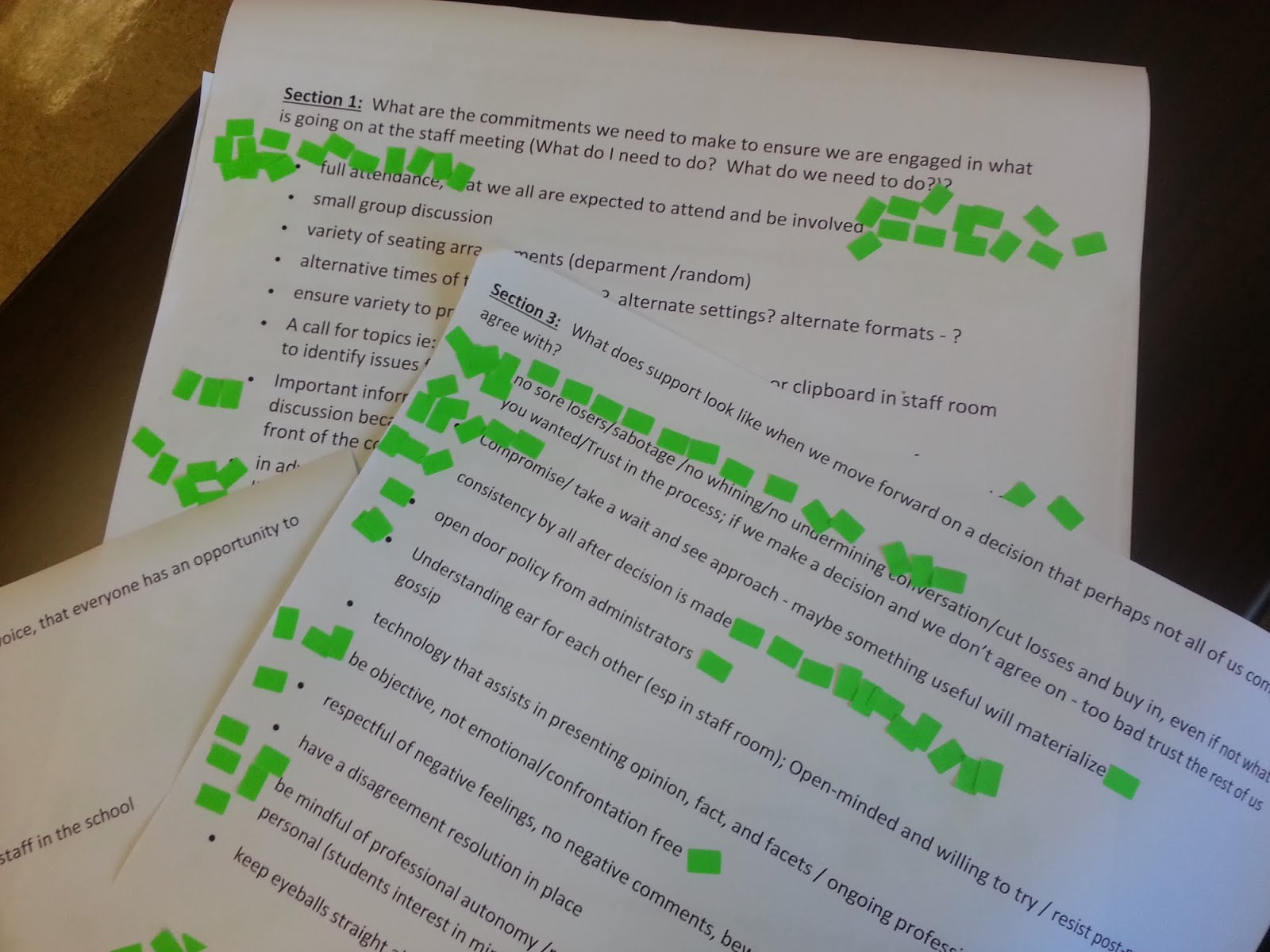
As a result of our work at that initial staff meeting, our Coordinator Group put together just such an activity--the 10 Dot Gallery Walk--which allowed our staff to interact with each other around the ideas for staff meetings that we had collected.  As a group, our staff were able to prioritize the suggestions and ideas in front of them for creating the norms of an inclusive staff meeting.  It looked like this:


The engagement of the staff in this activity was notable--people were asking each other for clarification, looking for similar threads on other sheets, and truly being thoughtful in the placement of their 'priority dots'.  And in the end, we got a product that gave us a distinct visual in terms of where the priorities of our staff truly were.  

But that wasn't enough.  

In order to continue to make this process authentic, we needed to take these priorities and craft them into a concise and easily articulated list of commitments that reflected the views of the group.  Again, it would be quick and easy for me to just put these into words that I thought represented the views of the group, but that would not be in the spirit of the activity (nor would it be terribly accurate).  So, as a Coordinator Group with representatives from each department, we began to sort and collect similar terms that were the highest priority for staff (denoted by the dots) and find themes.  The group came up with three temporal themes for staff meetings--Pre-Meeting, During the Meeting, and After the Meeting. Then, I became the scribe, the group became 10 'muses', and we thought with our mouths, debated, wordsmith-ed, re-wrote, and teased out 10 commitments.  They look like this: 

Pre- Meeting
  • we will submit items to the agenda, read the agenda and supporting documents prior to the staff meeting
  • we will attend the meeting and be engaged and involved
  • we will clear purpose and agenda to each staff meeting
  • we will have food for the meeting

During the Meeting
  • we will maintain a light, positive tone with a spirit of collegiality
  • we will come to the meeting with an open mind and consider new ideas and points of view
  • we will have the parameters of the decision-making process will be clearly articulated prior to the discussion
  • we will respect that there may be a need for additional time/input about a decision
  • we will use a variety of creative solutions (ie. anonymous votes, small group forums) to ensure each staff member has a voice

After the Meeting

  • we will trust in our collegial decision-making process
  • We will honor the decision made at the meeting and move forward!

But we are not done yet!  At our November staff meeting, each member of the group will present one of these commitments to the staff and talk them through how we got to that particular commitment from the original, gallery-walk document.  Once we have done this for each of the bullets above, we will ask the entire staff for any further refinements that need to be made.  At the December staff meeting, we will unveil our commitments to each other so that staff meetings actually honor the vision that we have collectively articulated.

From the outside, what we have done here might seem like a long and arduous process.  I guess I could have just made up some commitments and said this is what I want, what I expect.  Or I could have grabbed a list of norms from a book or article, and had us modify them to work for us.  That would have been much faster.

But this is not a race.  With something as important as how we will work together in a large group setting, faster is not always better.

I think it has been time well spent.  The product that we are creating is authentic and representative of each of us:  through the tasks that we have done, we have been required to participate in the process, we modeled and used higher-order thinking skills, we are implementing a tangible product, and we have even touched a technology that we can use in our classes in the process.

Sounds a lot like what we set out to do in the first place, and I look forward to the final product.  I am very proud of our teachers for working through this--congratulations to our staff!


- cross-posted in the Sa-Hali Educational Sandbox


Tuesday, October 8, 2013

Engaging Our Faculty in PRTI

Over the last few weeks, our staff has been working feverishly to create structures that enhance and ensure adult and student learning.  We are refining our collaborative commitments to one another to ensure positive communication, problem discovery and risk-taking in our whole staff and collaborative meetings.  We have designed and begun to implement a collaborative model that enables self-organized learning within a framework of defining guaranteed curricula and recognized struggle points.  And we have done all of this within the context of a collectively defined vision that has been initially formulated by our teachers, but will also be co-created by our parents and our student body. 

As we are doing this while the school year is in progress, suffice it to say the first five weeks have been crazy.  Crazy good.

But this afternoon at our faculty meeting, we had more work to do in terms of the interventions that we have in place to ensure student learning at our school. Over the course of last year, Sa-Hali made a commitment to Pyramid Response to Intervention. As we know, PRTI strives to blur the lines between general and special education to create a systematic means to serve all students, regardless of whether they are learners who struggle significantly or just need some minor 'fine-tuning' to get back on track. And while we have created our CORE team and numerous structures to support student learning through the lens of PRTI, we realized as a group at our Student Services collaborative team meeting last Wednesday (which I was lucky enough to be a part of) that we needed to find a way to familiarize our staff with these structures in such a way that they would be comfortable using them in the future.  

Hmmm. How about a flashy Powerpoint with lots of bullets and animations describing each of the structures that we have at our school followed by a handout at the end that the faculty could take with them?

Yawn. Paper airplane coming up. The design team scuttled that thought in a hurry. "We tried that once, remember?"

Our design team wanted to stay aligned with our guiding principles for faculty meetings around staff engagement and adult learning (from a post early last month called "Inclusive Staff Meetings"), which meant co-creating an activity that:
  • requires the engagement of each staff member 
  • models the use of higher order critical thinking skills for our staff (interpretation, prediction, selection, synthesis, etc) in an exercise they can adapt and apply to their classes 
  • leads to the implementation of a tangible product (such as the chart from our Social Justice class) that is reflective of each of our voices, and subsequently guides us for all of our future staff meetings.
So, in the span of a 45 minute collaborative meeting (and an incredible effort from our Student Services Coordinator and her staff leading up to our faculty meeting), the team created an activity that looked like this (yes, these are the actual handouts below--cool).


  • our staff was divided into groups of 5-6 and given five blank "Scenario Sheets"--these sheets had a large space for "Teacher Interventions" (Tier 1) interventions for group brainstorming plus a blank flowchart below
  • each of our twelve Tier 2 and Tier 3 interventions with detailed descriptions were put on to different colors of paper, and each group member given two of these to role play for the other group members
  • the staff was presented with 5 "Student Scenarios" that described fictitious student situations of varying levels of complexity -- things such as

  • in their groups, teachers (equipped with their roles) brainstormed their Tier 1 responses, shared their roles with the group, and evaluated the scenario, and then assessed which other interventions would be most appropriate to help the fictitious student in question as well as the sequence in which they would be enacted.
  • groups then had to report out to the large group so that we could compare solutions, clarify any questions about our intervention mechanisms, and suggest alterations.
I was stunned by the response of the staff to this exercise. Because of the structure of the exercise that our Student Services team presented, I saw 40 professionals dig in, ask questions, respectfully challenge the responses of members of their own groups and other groups, wave the activity leaders off and shout "we need more time with this one", flip through the interventions and shake their heads while saying things like "we don't need to go to that level yet" and "we need to make a connection with kids like this". It was awesome.

And at the end of the exercise, our amazing Student Services Coordinator collected all of the scenario sheets from each of the groups so that she and the rest of the Student Services team could analyze each of the responses to see if there were any gaps that she needed to fill with the staff during their next collaborative meeting. She also wanted to use the results to shape and tailor our PRTI flowchart to ensure the staff could efficiently use the interventions available to them for our students.  

But that's not all.

In the spirit of reflection, as a staff, we looked at the activity that we did. Much like in the past, we could have done a handout. We could have done a 'think-pair share'. But there would have been little guarantee of learning. As a group, we analyzed this PRTI task through the lens of what we were 'saying, doing, and writing' so that our group could 'learn the work by doing the work'.

Our Technology Coordinator and English Coordinator are well-versed in Photoshop for poster creation. With their assistance, our school will design and implement a less-conventional, student-appealing PRTI graphic complete with terms in 'kid-speak' that will be posted in each classroom (and on our webpage). This will allow our students, parents and staff to know each of the supports that will be enacted should students struggle with the outcomes in our courses.

This process took (and will continue to take) a great deal of effort from numerous people on a variety of fronts. However, the very thrust of PRTI is to blur the lines between special services and the regular classroom. By having the entire faculty co-create our PRTI model through an collaboratively developed "case-study"-style activity that we found to require adult participation and learning through our task analysis, I believe we will have significantly more buy-in than we would have by simply listing our interventions on a Powerpoint and hoping people would utilize them.

If you have ideas or suggestions on how we can improve this process at our school, please comment and let us know!